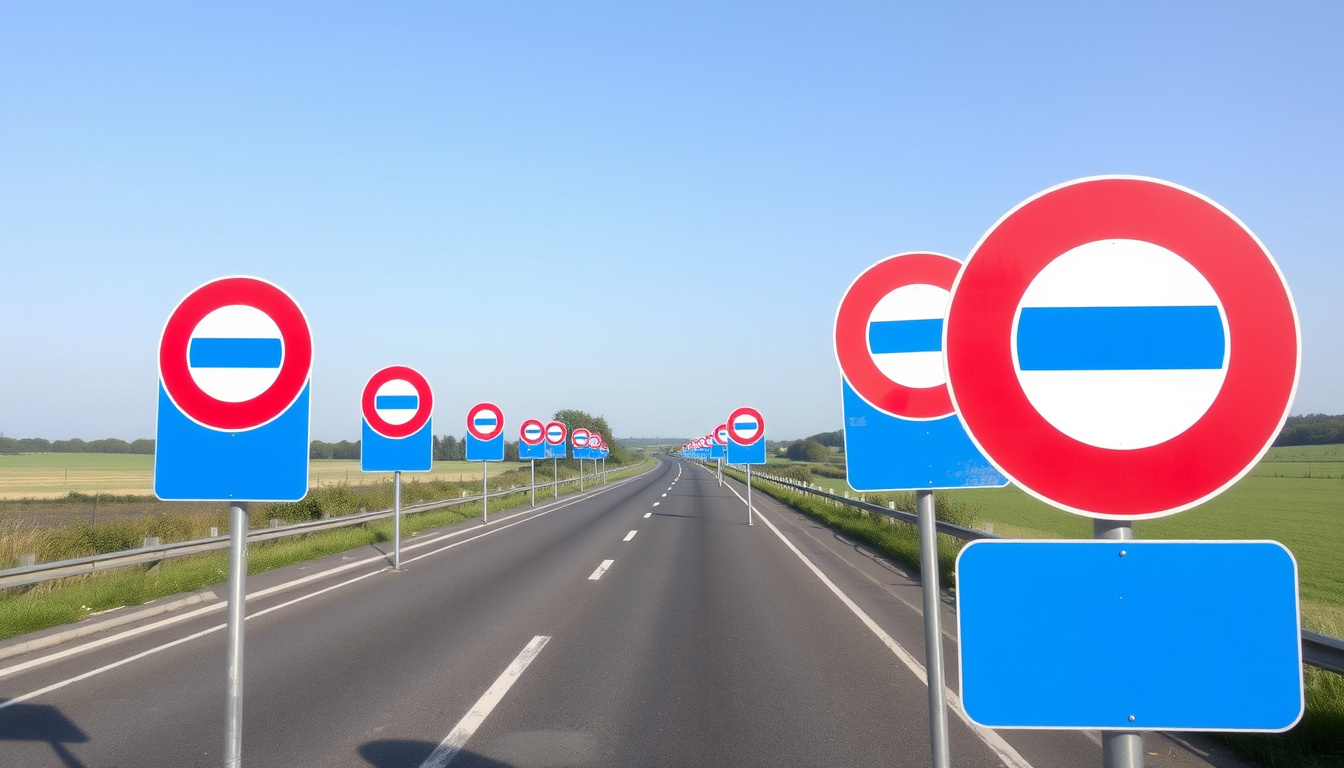

Highway Code Rule 240 establishes strict controls on where drivers may stop or park on UK roads. Clearways represent one of the most restricted categories, designed to keep traffic flowing on major routes. Understanding these rules helps drivers avoid penalties and contributes to road safety.
The regulation distinguishes between several types of restricted zones, each with specific conditions. While some areas permit brief stops for passengers or deliveries, clearways operate under essentially blanket restrictions. This article explains what a clearway is, when stopping is permitted, and what consequences apply for violations.
Drivers should familiarise themselves with the relevant signs and markings, as failure to comply can result in fixed penalty notices. The rules apply across England, Scotland, and Wales, though local authorities may enforce additional restrictions in their areas.
What is a Clearway?
A clearway is a stretch of road where stopping and parking are prohibited at all times on the main carriageway. These zones are marked with a red circular sign bearing the word “Clearway” along with an explanatory plate detailing specific restrictions.
The primary purpose of clearways is to maintain continuous traffic flow on busier roads, particularly those forming part of strategic routes. By preventing stops, these zones reduce congestion and improve safety for all road users.
Clearways differ from other restricted areas in their absolute nature. Unlike urban clearways, which may allow brief passenger pick-up during certain hours, standard clearways impose round-the-clock restrictions except in genuine emergencies.
Clearway signs feature a red circle with white background and black “Clearway” text. An additional plate beneath the sign specifies any time restrictions or additional prohibitions, such as no loading.
Key Facts at a Glance
| Aspect | Detail |
|---|---|
| Definition | No stopping or parking on main carriageway at any time |
| Sign appearance | Red circle with “Clearway” text and information plate |
| Governing rule | Highway Code Rule 240 |
| Primary purpose | Maintain traffic flow on major routes |
| Loading allowance | Not permitted on standard clearways |
| Passenger pick-up | Not permitted on standard clearways |
Understanding Clearway Signs
The red circular sign indicates a prohibition that applies to all vehicles. The accompanying information plate may specify operating hours or additional restrictions such as no loading. Drivers should always read both the main sign and any plates when approaching a clearway zone.
Signs are positioned at the start of clearway zones and repeated at intervals along the route. In areas with multiple restrictions, additional plates may clarify which types of stopping are prohibited.
- Standard clearway signs indicate complete prohibition on stopping
- Urban clearway signs include time plates specifying permitted hours
- Loading restriction plates appear where goods vehicles may not stop
- Emergency exception signs may indicate services available nearby
When Can You Stop on a Clearway?
The general rule under Highway Code Rule 240 prohibits stopping on a clearway at any time. The only recognised exception on a standard clearway is for genuine emergencies involving vehicle breakdown, accident, or medical situations requiring immediate stopping.
Unlike roads with double white lines, where limited loading and passenger drop-off may be permitted, clearways do not allow these activities. The restriction applies regardless of duration, time of day, or whether the vehicle is attended.
Permitted Stops
- Vehicle breakdown requiring the car to stop immediately
- Road traffic accident requiring emergency response
- Medical emergency affecting the driver or passengers
- Directing traffic by an authorised person
- Obeying a police officer’s signal to stop
What Is Not Permitted
- Stopping to use a mobile phone
- Rest breaks or rest stops
- Waiting for passengers
- Checking directions or maps
- Loading or unloading goods
- Checking or adjusting sat-nav
Rule 240 specifies that stopping is generally prohibited on clearways. However, unlike urban clearways or roads with double white lines, no provisions exist for loading, unloading, or passenger pick-up and set-down on standard clearways.
Motorway Clearway Rules
Motorways feature their own specific restrictions under Rule 240. Drivers must not stop on the carriageway, emergency area, or hard shoulder except in a genuine emergency. Rules 270 and 271 provide additional guidance on motorway stopping procedures.
If a breakdown occurs on a motorway, drivers should attempt to reach an emergency area. If this is not possible, the vehicle should be moved as far left as possible, hazard lights should be activated, and all occupants should exit via the left-hand doors and stand behind safety barriers.
Clearway vs Bus Clearway: Key Differences
The distinction between a clearway and a bus clearway is significant and often misunderstood. While both restrict general stopping, they operate under different principles and affect different types of traffic.
Standard Clearway Characteristics
Standard clearways ban all stopping on the main carriageway at all times. These zones prioritise traffic flow above all other considerations and do not permit exceptions for passenger activities or commercial operations.
- Round-the-clock prohibition on stopping
- No loading or unloading permitted
- No passenger pick-up or set-down
- Signs indicate full prohibition
Bus Clearway Characteristics
Bus clearways relate to bus lanes rather than the main carriageway. Under Rule 141, any vehicle may enter a bus lane to stop, load, or unload if not specifically prohibited by signs. This creates a practical distinction where general traffic can briefly access bus lanes for legitimate purposes.
- Applies to bus lanes rather than main carriageway
- Other vehicles may stop if signs permit
- Loading and unloading allowed in designated areas
- Passenger pick-up and set-down generally permitted
Urban Clearways
Urban clearways represent a middle ground between standard clearways and bus lanes. During specified hours, brief stops for passenger pick-up and set-down are permitted, though loading remains prohibited.
These zones typically appear in busier urban areas where some flexibility benefits local businesses and residents while still maintaining traffic flow. Signs include time plates indicating when restrictions apply.
When encountering any restricted zone, drivers should check both the main sign and any supplementary plates. Time restrictions, vehicle type limitations, and specific activity allowances are commonly detailed on these plates.
Penalties for Stopping on a Clearway
Enforcement of clearway restrictions falls to the relevant local authority or police force. Violations typically result in fixed penalty notices, with fine amounts varying according to the enforcing authority and the specific location.
The governing legislation includes the Road Traffic Regulation Act 1984 (sections 5, 6, and 8) and the Road Traffic Act 1988 (sections 21(1) and 36). These powers enable authorities to issue penalties without court proceedings in most cases.
Typical Penalty Structure
- Fixed penalty notices range from £60 to £130 depending on location
- Red route violations often attract the higher end of the scale
- Reduced penalties available for early payment
- Persistent violations may result in escalated enforcement
- Vehicles may be removed if causing obstruction
Payment and Appeals
Drivers receiving penalty notices have the right to challenge the citation if they believe it was issued incorrectly. Appeals are typically handled through the enforcing authority’s formal complaints process before progressing to traffic tribunals if necessary.
Evidence such as photographs, witness statements, or proof of emergency circumstances can support either payment or appeal. Drivers should retain any documentation relating to the circumstances of the stop.
Exact penalty amounts are set by individual local authorities and may change over time. The figures cited reflect typical ranges on red routes and urban clearways. Drivers should consult their local authority’s website for current penalty structures.
Highway Code Rule 240: Background and Evolution
The prohibition on stopping in restricted areas, including clearways, has formed part of the Highway Code for several decades. Rule 240 has remained fundamentally consistent, reflecting the enduring need to regulate traffic flow on major roads.
The Highway Code sections 238 to 252 collectively address waiting and parking restrictions across various road types and conditions. Rule 240 specifically targets areas where stopping would cause particular obstruction or danger.
Related Rules
- Rule 238: Addresses waiting and parking restrictions on yellow lines
- Rule 239: Advises drivers to use off-road parking wherever possible
- Rule 243: Identifies additional no-stop zones near schools, bus stops, and junctions
- Rule 270/271: Provides guidance on motorway stopping in emergencies
Consistency Across Jurisdictions
The Highway Code applies throughout England, Scotland, and Wales. Northern Ireland operates under separate legislation with equivalent provisions. Drivers travelling between jurisdictions should note that while the principles remain similar, specific local variations may exist.
Road traffic regulations, including clearway restrictions, are periodically reviewed to address changing traffic patterns and safety considerations. Updates are published through official government channels and incorporated into revised Highway Code editions.
What We Know and What Remains Unclear
Several aspects of clearway rules are well-established through the Highway Code and supporting legislation. However, some practical questions remain without definitive answers in the published guidance.
Rule 240 clearly prohibits stopping on clearways. Emergencies represent the only recognised exception on standard clearways. Loading and unloading are not permitted. The relevant legislation includes RTRA 1984 and RTA 1988. Penalties are typically issued as fixed penalty notices.
Specific fine amounts are not published in the Highway Code and vary by authority. Whether minor mechanical issues constitute “emergencies” is not explicitly defined. Local variations in enforcement approach are not documented in central guidance.
Why Clearways Exist
Clearways serve two interconnected purposes that benefit both individual drivers and the wider community. Understanding these purposes helps drivers appreciate why the restrictions are necessary and strictly enforced.
Traffic Flow Management
Major roads are designed to move large volumes of traffic efficiently. Any stopped vehicle, regardless of duration, creates a ripple effect of congestion that can affect thousands of journeys. By prohibiting all stops, clearways maintain the capacity these roads were built to provide.
Traffic modelling demonstrates that even brief stops at pinch points significantly increase journey times for all road users. Clearways eliminate these bottlenecks and support reliable journey planning for both public and private transport.
Road Safety
Stopped vehicles on major roads create hazardous situations for drivers, passengers, and pedestrians. The sudden need to change lanes to avoid an obstruction increases accident risk. Emergency service vehicles face additional challenges accessing incidents where other vehicles have stopped illegally.
Clearways also reduce the risk of secondary accidents caused by slow-moving traffic filtering around stopped vehicles. This is particularly important on roads with higher speed limits where stopping distances are longer.
Official Sources and References
The primary authoritative source on clearway rules is the Highway Code Rule 240. The official publication is maintained by the Department for Transport and updated periodically to reflect regulatory changes.
“You MUST NOT stop or park on a clearway.” — Highway Code Rule 240
Additional guidance is available through Gov.uk’s Highway Code waiting and parking section, which provides detailed explanations of related restrictions and enforcement provisions.
- Highway Code Rule 240 — highwaycode.org.uk
- Waiting and Parking (238-252) — gov.uk
- Road Traffic Regulation Act 1984
- Road Traffic Act 1988
Summary
Stopping on a standard clearway is prohibited at all times under Highway Code Rule 240. The only permitted exception is for genuine emergencies. Unlike urban clearways or roads with double white lines, clearways do not allow loading, unloading, or passenger pick-up and set-down.
Violations result in fixed penalty notices, with amounts varying by enforcing authority. Drivers should familiarise themselves with clearway signs and supplementary plates to avoid penalties. Understanding these rules supports both personal compliance and broader road safety objectives.
For those preparing for theory tests or seeking to understand driving regulations more broadly, resources on UK stamp duty thresholds and other regulatory guides provide additional context on navigating UK requirements.
Frequently Asked Questions
Can I stop on a clearway to answer my phone?
No. Stopping to use a mobile phone does not constitute an emergency. Drivers should find a safe, legal place to stop before using any device.
Can I stop on a clearway to check my sat-nav?
No. Adjusting or checking a sat-nav while parked on a clearway is not permitted. Drivers should programme routes before beginning journeys.
What is the difference between a clearway and an urban clearway?
Standard clearways prohibit all stopping at all times. Urban clearways allow brief passenger pick-up and set-down during specified hours indicated on signs.
Can I load groceries on a clearway?
No. Loading and unloading are not permitted on standard clearways. Drivers must find alternative parking away from the clearway zone.
What happens if my car breaks down on a clearway?
A genuine breakdown may be considered an emergency, permitting stopping. Drivers should move the vehicle as far from traffic as possible and activate hazard lights.
Are clearway rules the same across the UK?
The Highway Code applies throughout England, Scotland, and Wales. Northern Ireland has equivalent provisions under separate legislation.
Can I stop on a clearway to drop off a passenger?
No. Unlike urban clearways, standard clearways do not permit passenger pick-up or set-down. This restriction applies regardless of duration.

Amelia Grant is Local Government Editor at RegionalReport.co.uk, covering council decisions, regional public policy, combined authorities, planning, housing and transport.