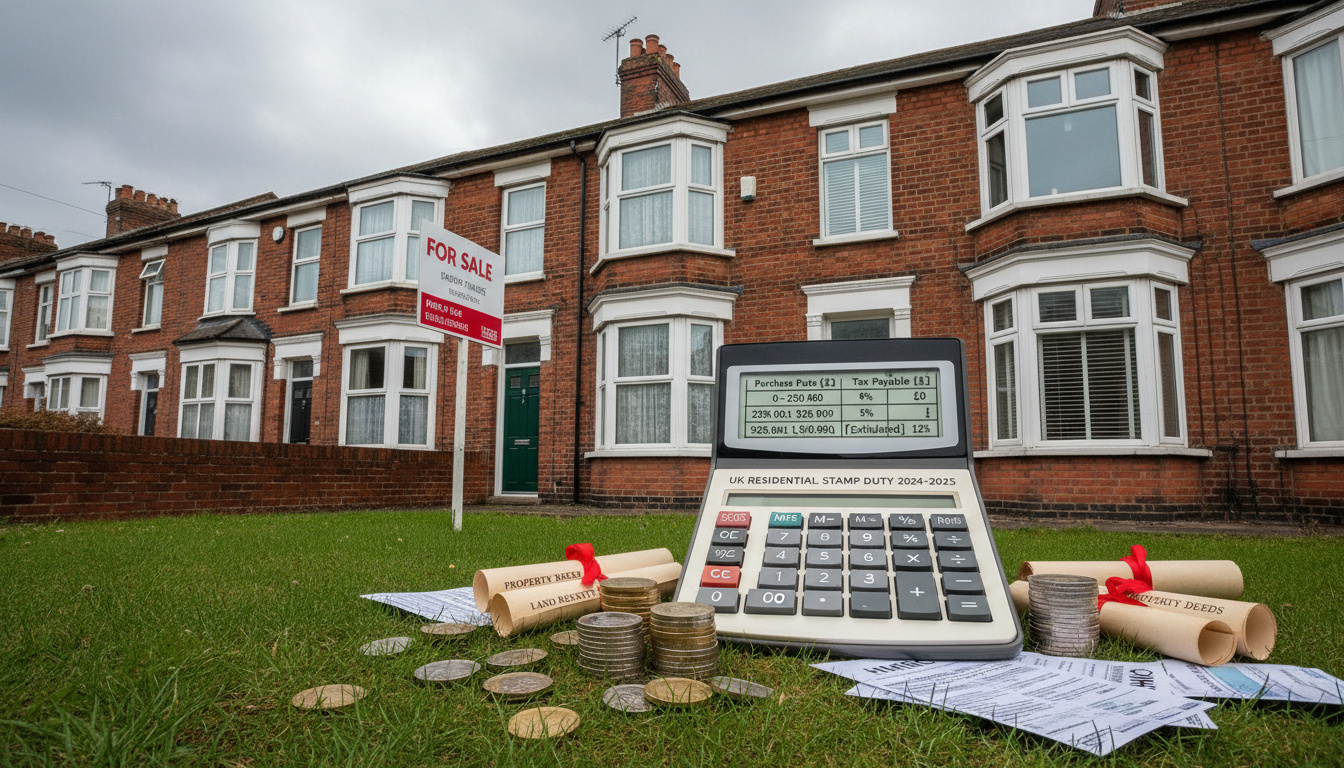
Purchasing residential property in England or Northern Ireland triggers Stamp Duty Land Tax when the price exceeds specific thresholds. The exact liability depends on the purchase price, buyer classification, and whether the transaction completes during the current temporary relief period ending 31 March 2025.
Recent legislative changes implemented on 31 October 2024 adjusted both the nil-rate bands and additional property surcharges. These modifications affect everyone from first-time buyers purchasing starter homes to investors acquiring buy-to-let portfolios.
The UK Stamp Duty Land Tax (SDLT) Overview for 2024-2025 establishes the framework governing these calculations, though specific rates vary significantly based on individual circumstances.
How is stamp duty calculated in the UK?
HMRC applies SDLT progressively, meaning successive portions of the purchase price fall into different percentage bands rather than charging a flat rate on the entire amount. This structure prevents sharp tax spikes at threshold boundaries.
- The nil-rate threshold currently stands at £250,000 for standard residential purchases, twice the permanent level
- First-time buyer relief eliminates liability entirely on the first £425,000 for qualifying purchasers
- Additional properties incur a 5% surcharge atop standard rates, increased from 3% in October 2024
- Corporate bodies purchasing residential properties worth over £500,000 face a 17% rate
- Temporary thresholds remain valid only until 31 March 2025
- Scotland and Wales maintain entirely separate property taxation systems
- Calculations must use the completion date rather than exchange date for determining applicable rates
| Price Band | Standard Rate | First-Time Buyer | Additional Property |
|---|---|---|---|
| Up to £125,000 | 0% | 0% | 5% |
| £125,001 – £250,000 | 0% | 0% | 7% |
| £250,001 – £425,000 | 5% | 0% | 10% |
| £425,001 – £625,000 | 5% | 5% | 10% |
| £625,001 – £925,000 | 5% | 5% | 10% |
| £925,001 – £1.5 million | 10% | 10% | 15% |
| Over £1.5 million | 12% | 12% | 17% |
Accuracy requires consulting the official GOV.UK SDLT calculator, as third-party tools may not reflect the most recent regulatory adjustments.
What are the current stamp duty thresholds and rates?
The fiscal landscape shifted dramatically on 31 October 2024, when the Chancellor implemented temporary adjustments valid through 31 March 2025. During this window, purchasers replacing their main residence pay zero SDLT on the first £250,000 of the property value, a significant increase from the previous £125,000 threshold.
Standard Residential Purchases
For buyers replacing their principal residence, the 0% band extends to £250,000. Above this figure, marginal rates apply: 5% on the portion between £250,001 and £925,000, 10% between £925,001 and £1.5 million, and 12% on any amount exceeding £1.5 million. These bands align with Current SDLT Rates and Thresholds published by HM Revenue & Customs.
Temporary Provisions
The elevated thresholds represent time-limited measures rather than permanent tax reform. The official government publication confirms these rates apply specifically to transactions completing between 31 October 2024 and 31 March 2025.
Unless extended by subsequent legislation, the nil-rate threshold reverts to £125,000 on 1 April 2025. Purchasers exchanging contracts now but completing after this date face substantially higher tax liabilities based on the lower permanent threshold.
What stamp duty relief is available for first-time buyers?
First-time buyer relief offers substantial savings for those entering the property market, provided strict eligibility criteria are met. Both purchasers must have never owned residential property anywhere in the world, and the acquisition price cannot exceed £625,000.
Qualifying Criteria
Eligibility requires that neither party has previously held a freehold or leasehold interest in a dwelling. The relief applies specifically to purchases intended as the buyer’s only or main residence. Buy-to-let acquisitions automatically disqualify applicants regardless of personal occupancy history.
Relief Calculations
Qualifying purchasers pay zero SDLT on the first £425,000. The portion between £425,001 and £625,000 attracts 5%. Properties exceeding £625,000 receive no relief whatsoever, with standard rates applying to the entire purchase price. This structure effectively eliminates tax liability for the majority of starter homes outside London and the South East.
When purchasing jointly, all buyers must satisfy first-time buyer status. If one party previously owned property through inheritance or as a trustee, even without residing there, the relief is forfeited entirely.
Detailed scenarios appear in guidance from consumer finance specialists, though official HMRC determination remains authoritative for specific cases.
Do second homes or buy-to-let properties pay extra stamp duty?
Purchasers acquiring additional dwellings face significantly higher tax burdens through the Additional Dwelling Supplement. This surcharge applies to second homes, buy-to-let investments, and properties purchased by corporate entities.
Additional Dwelling Rates
From 31 October 2024, the surcharge increased from 3% to 5%, applied atop standard rates. Consequently, additional properties attract minimum 5% tax even within the £125,000 band, rising to 17% for acquisitions exceeding £1.5 million. Data from commercial property analysts confirms these bands apply universally to non-main-residence purchases.
Replacement Exceptions
Buyers replacing their main residence may avoid the surcharge even if temporarily owning two properties, provided they dispose of the previous main residence within 36 months. Conversely, purchasing a new main residence while retaining the existing property triggers the additional 5% charge.
Companies acquiring residential properties worth over £500,000 face a flat 17% rate, increased from 15% in the October 2024 adjustment. This measure specifically targets enveloped dwellings purchased by non-natural persons.
Examples from property portals demonstrate how the surcharge affects total acquisition costs across different price points.
When do stamp duty rates change next?
The current rate structure operates on a fixed timeline with explicit expiration dates. Understanding this chronology proves essential for contract timing and financial planning. For those interested in the latest updates, Racing Post fast results today provides comprehensive details.
- : Nil-rate threshold increased to £250,000; additional dwelling surcharge rose to 5%; first-time buyer relief threshold set at £425,000
- to : Temporary rates remain in effect for all qualifying completions
- : Current temporary provisions expire unless renewed by statutory instrument
Sources at international property consultancies note that the March 2025 cliff edge may trigger conveyancing bottlenecks as buyers rush to complete before rate increases.
What is certain and what remains uncertain?
| Established Facts | Uncertain Elements |
|---|---|
| Rates valid until 31 March 2025 per statutory instrument | Post-March 2025 threshold levels |
| 5% surcharge on additional dwellings | Potential Budget adjustments to first-time buyer relief |
| £425,000 first-time buyer nil-rate cap | Long-term government strategy on property taxation |
| 17% corporate rate on £500,000+ properties | Whether temporary thresholds become permanent |
Why do stamp duty thresholds exist?
Stamp Duty Land Tax serves dual governmental objectives: revenue generation and market modulation. Progressive thresholds ensure that luxury purchases contribute proportionally more to the Exchequer while entry-level acquisitions remain accessible.
The 2024 adjustments specifically target first-time buyer support and additional property deterrence. By elevating the nil-rate band to £425,000 for new market entrants, policymakers aim to reduce deposit barriers, whereas the 5% surcharge on second homes attempts to moderate investment demand in overheated markets.
Regional variations reflect devolved taxation powers, with Scotland’s LBTT and Wales’s LTT operating independently of English fiscal policy.
What do official sources confirm?
The nil-rate threshold is £250,000 for residential properties. This temporary increase applies from 31 October 2024 to 31 March 2025.
— HM Revenue & Customs, Stamp Duty Land Tax Rates 31 October 2024 to 31 March 2025
Official documentation emphasizes that calculators must use completion dates rather than exchange dates when determining applicable rates. The GOV.UK residential property rates guidance remains the definitive reference for self-assessment.
What should buyers remember?
Current liabilities depend entirely on completion timing before 31 March 2025, buyer classification, and property usage intentions. Always verify calculations against the UK Stamp Duty Land Tax (SDLT) Overview for 2024-2025 and consult qualified conveyancers regarding specific transaction structures.
Frequently Asked Questions
Does stamp duty apply to new builds?
Yes, SDLT applies equally to new build and existing residential properties. The tax calculation uses the purchase price shown on the transfer deed, regardless of construction date. Some developers offer incentives that effectively cover the duty, but this remains a contractual arrangement rather than a tax exemption.
What are the stamp duty differences between Scotland and England?
Scotland applies Land and Buildings Transaction Tax (LBTT) with different thresholds: 0% up to £175,000 for standard residential purchases, and higher rates for additional properties starting at 6%. England and Northern Ireland use SDLT with the £250,000 temporary threshold.
How do I pay stamp duty after completing a purchase?
Buyers must submit an SDLT return and pay any tax due within 14 days of completion. Solicitors typically handle this submission through the HMRC online portal, though buyers remain legally responsible for ensuring timely payment and accurate self-assessment.
Can stamp duty be added to my mortgage?
Lenders prohibit adding SDLT to mortgage advances. Buyers must fund the tax through separate savings or gifted deposits. Attempting to capitalise the duty into the loan amount would constitute mortgage fraud and likely trigger loan withdrawal.
What counts as a main residence for SDLT purposes?
A main residence is determined by factors including where the buyer is registered to vote, the address used for correspondence, proximity to employment, and where the purchaser spends most time. Intention at purchase point matters significantly in disputes.
Are there any stamp duty exemptions?
Exemptions include property transfers following divorce or dissolution, inheritance upon death, and transactions where no payment changes hands. Additionally, purchases below £125,000 (or £250,000 until 31 March 2025) attract zero tax liability.
How does the 3-year replacement rule work?
Buyers replacing their main residence can claim refunds of the 5% additional dwelling surcharge if they sell their previous main residence within 36 months of completing the new purchase. Claims must be submitted to HMRC within 12 months of selling the former home.
Do first-time buyers pay stamp duty on shared ownership?
First-time buyer relief applies to shared ownership purchases if the total market value does not exceed £625,000. Buyers may elect to pay SDLT on the full market value upfront or pay gradually on staircuring purchases, though the latter forfeits first-time buyer status.

Henry Wallace is Managing Editor at RegionalReport.co.uk, running the daily news list, the regional publishing schedule and newsroom workflow.