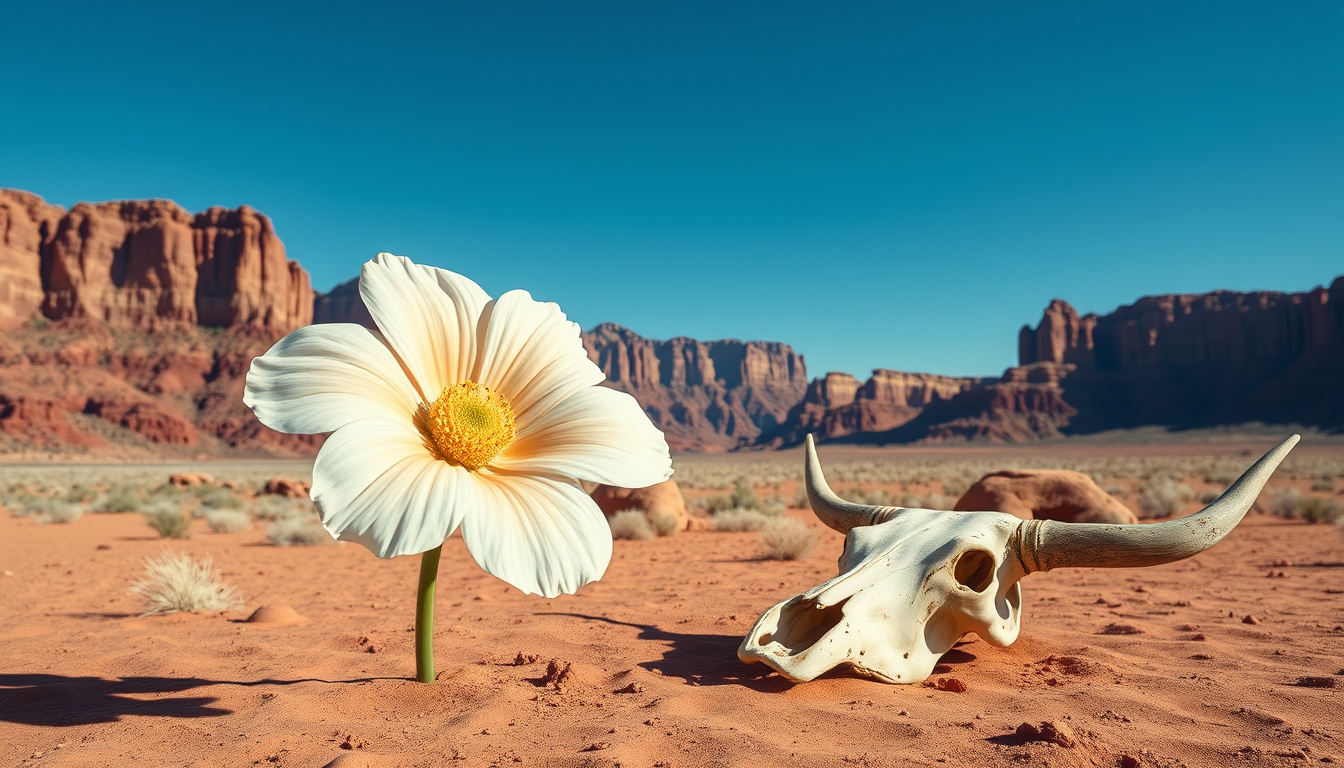
Georgia O’Keeffe stood at the center of American Modernism for more than seven decades, building a body of work that ranged from magnified flowers to desert skulls, New York skyscrapers, and the luminous landscapes of northern New Mexico. Born in Wisconsin in 1887, she became one of the most recognizable figures in twentieth-century American art and was sometimes called the “mother of American modernism.”
Her artistic partnership with Alfred Stieglitz, who exhibited her drawings in 1916 and later became her husband, placed her at the heart of New York’s modern art scene. But O’Keeffe’s vision remained distinct: she transformed natural forms into simplified, powerful images that moved easily between representation and abstraction.
After 1929, New Mexico reshaped her art, and she eventually settled there permanently. Her homes and studios in Abiquiú and near Ghost Ranch are now preserved as cultural landmarks, alongside the Georgia O’Keeffe Museum in Santa Fe.
Who Was Georgia O’Keeffe?
- Full Name: Georgia Totto O’Keeffe
- Born / Died: November 15, 1887 – March 6, 1986
- Known For: Magnified flowers, New Mexico skulls, desert landscapes
- Most Expensive Work: Jimson Weed/White Flower No. 1 ($44.4 million)
- O’Keeffe redefined the boundary between abstraction and representation in American art.
- Her flowers are among the most reproduced images in modern art, yet their intended meaning is often misinterpreted.
- She was one of the first female artists to achieve global critical and economic success on her own terms.
- She developed a distinct visual vocabulary rooted in form, scale, and color, independent of major modernist schools.
- The Tate Modern retrospective has solidified her standing in contemporary art discourse.
- Her preserved homes, studios, and archives in New Mexico have made her an enduring cultural figure.
| Field | Detail |
|---|---|
| Full Name | Georgia Totto O’Keeffe |
| Born | November 15, 1887, Sun Prairie, Wisconsin, USA |
| Died | March 6, 1986, Santa Fe, New Mexico, USA |
| Spouse | Alfred Stieglitz (m. 1924–1946) |
| Education | Art Institute of Chicago, Art Students League of New York, Columbia University |
| Movement | American Modernism, Precisionism |
| Known For | Flower paintings, skulls, landscapes, abstraction |
| Official Museum | Georgia O’Keeffe Museum, Santa Fe (opened 1997) |
| Major Exhibitions | Tate Modern (2023–2024), MoMA retrospective (1971) |
| Awards | National Medal of Arts (1985), Presidential Medal of Freedom (1977) |
Georgia Totto O’Keeffe was born on November 15, 1887, near Sun Prairie, Wisconsin, the second of seven children. She studied at the Art Institute of Chicago and the Art Students League of New York, and later taught art in Virginia, South Carolina, and Texas.
In 1915, after absorbing the ideas of Arthur Wesley Dow, she destroyed much of her earlier work and moved toward abstraction and a more personal visual language. Her drawings reached Alfred Stieglitz, who exhibited them in 1916; their connection became both professional and romantic. She moved to New York in 1918, where her skyscraper paintings helped build her name in the modern art scene.
Stieglitz was her husband and artistic partner until his death in 1946. His photographs of O’Keeffe, held in the Library of Congress collections, shaped her public image for decades. Beginning in 1929, she spent long periods in northern New Mexico. The landscape became central to her art, and she later settled permanently in the region, living in Abiquiú and working near Ghost Ranch. She died in Santa Fe on March 6, 1986, at the age of 98.
What Are Georgia O’Keeffe’s Most Famous Paintings?
O’Keeffe’s most recognizable images fall into a few families: flowers, bones, desert landscapes, and urban architecture. Some have become so famous that they circulate far beyond museum walls.
The Magnified Flowers: Jimson Weed, Black Iris, and Poppies
Her close-up flower paintings are among her best-known works, enlarged beyond life size and rendered with bold color and precision. Jimson Weed, Black Iris, and the poppy paintings turn a small natural object into a large, almost abstract composition. Jimson Weed/White Flower No. 1 is her most expensive work, with an auction price of $44.4 million.
Skulls and Bones: Ram’s Head with White Hollyhock and Little Hills
In New Mexico, O’Keeffe painted animal bones and skulls against desert skies, using them as stark symbolic forms tied to the landscape. Ram’s Head with White Hollyhock and Little Hills is a defining example, with the bone set against pale hills and open sky.
New Mexico Landscapes and Abstractions
Her desert paintings capture cliffs, hills, sky, and bones in simplified, luminous compositions shaped by the region’s dryness and light. Mountains, clouds, and the adobe architecture of the Southwest appear across her later work, transforming the American landscape into a modernist subject.
What Is the Georgia O’Keeffe Nativity Painting?
The phrase “Georgia O’Keeffe nativity painting” circulates in online searches, but it does not correspond to any documented work in the institutional catalogues associated with her name. It appears to be a search term rather than a reference to a known canvas in her oeuvre.
The phrase “Georgia O’Keeffe nativity painting” is not a documented title in her catalogued body of work. Established paintings such as Jimson Weed, Black Iris, and Ram’s Head with White Hollyhock and Little Hills should not be confused with unverified online labels.
Why Did Georgia O’Keeffe Paint Flowers and Skulls?
Few questions about O’Keeffe provoke as much debate as the meaning of her subjects. The Metropolitan Museum of Art describes her art as focused on the essential structure of subjects rather than literal realism, which helps explain why her flowers and bones read as both objects and ideas.
The Meaning of the Magnified Flowers
O’Keeffe spoke of the intimate world that opens up when a flower is truly looked at. Her magnified flowers force close-looking, turning a familiar natural object into an encounter with color and form. In popular culture, the paintings were often read through a Freudian lens as deliberate anatomical imagery, but O’Keeffe rejected that reading. Modern scholarship tends to follow her, focusing on abstraction and formal qualities, though the older interpretation persists.
The Allure of the Desert: Skulls and the Landscape
In New Mexico, bones were not morbid props. O’Keeffe collected them with friends during drives through the desert, and they became emblems of the landscape’s beauty and permanence. Her skull paintings present these objects with stillness and clarity, connecting life and death to the dry, bright world of northern New Mexico.
Addressing Common Myths: Feminism and Reclusiveness
O’Keeffe personally resisted the label “female artist,” preferring to be judged on the work itself. Her legacy as a trailblazer for women in the arts, however, is widely recognized, and feminist art history has claimed her as a central figure. She also was not the isolated recluse of legend. She valued solitude in New Mexico but remained connected to the New York art world and maintained a busy household of visitors at Ghost Ranch.
O’Keeffe explicitly rejected Freudian readings of her flower paintings. Museum scholarship today generally emphasizes abstraction and intense observation, even though the older interpretation remains common in popular culture.
Where Can You See Georgia O’Keeffe’s Paintings Today?
O’Keeffe’s work is easy to find in major museums, and one institution is dedicated entirely to her.
The Georgia O’Keeffe Museum in Santa Fe
The Georgia O’Keeffe Museum in Santa Fe is the most complete home for her work. Opened in 1997, the museum identifies her as one of the most significant artists of the twentieth century and highlights her flowers, cityscapes, landscapes, and bones as iconic contributions to American Modernism. The museum’s official account of her life is a primary reference for her New Mexico years.
Georgia O’Keeffe at Tate Modern
A major retrospective at Tate Modern in London ran across 2023–2024, bringing O’Keeffe’s work to British audiences. Tate’s artist page for O’Keeffe places her among the modern artists in its collection and offers an institutional perspective on her career.
Major Museums with O’Keeffe Collections
O’Keeffe’s work is held and interpreted by major institutions across the United States, including the Museum of Modern Art, the Metropolitan Museum of Art, the Smithsonian American Art Museum, the National Gallery of Art, the Art Institute of Chicago, and the Georgia O’Keeffe Museum. The National Gallery of Art and the Smithsonian American Art Museum both hold significant collections and regularly include her work in permanent and temporary displays.
Before traveling to see O’Keeffe’s work, check museum websites for current exhibitions, rotating displays, and digital access. The Georgia O’Keeffe Museum and several major collections have expanded virtual viewing options.
What Is the Timeline of Georgia O’Keeffe’s Life and Career?
The chronology below follows the biographical record assembled by the Georgia O’Keeffe Museum, the National Museum of Women in the Arts, and other institutional sources.
- — Born in Sun Prairie, Wisconsin.
- — Art education at the Art Institute of Chicago and the Art Students League.
- — First solo exhibition at Alfred Stieglitz’s 291 gallery.
- — Marries Alfred Stieglitz; begins her iconic flower paintings.
- — First summer painting in New Mexico, deeply inspired by the landscape.
- — Stieglitz dies; O’Keeffe makes New Mexico her primary residence.
- — Begins losing central vision due to macular degeneration; meets Juan Hamilton, who assists her later work.
- — Dies at age 98 in Santa Fe.
- — Georgia O’Keeffe Museum opens in Santa Fe.
- — Major retrospective at Tate Modern, London.
What Are the Myths and Facts About Georgia O’Keeffe?
Several myths about O’Keeffe have hardened into common knowledge. Some are accurate; others need qualification.
| Established information | What remains unclear |
|---|---|
| O’Keeffe valued solitude for her work but remained socially well-connected in the New York art scene and later maintained a busy household of visitors at Ghost Ranch. | The boundary between her private life and public persona is difficult to draw. The “recluse” image was shaped largely by media portrayal. |
| O’Keeffe denied Freudian interpretations of her flower paintings. | Whether any of the works carry unconscious symbolism cannot be settled, and the older interpretation persists in popular culture. |
| Her legacy as a trailblazer for women in the arts is widely recognized. | She personally resisted the label “female artist” and preferred to be judged on her work alone. |
| Stieglitz gave her first exhibition and was a decisive promoter of her work. | The exact degree of his influence is debated; O’Keeffe exercised her own artistic direction and managed her career with care. |
How Did Georgia O’Keeffe Shape American Modernism?
O’Keeffe helped create a distinctly American form of modernism. Rather than following European movements, she developed a visual language rooted in American subjects, scale, and color. Her art is widely described as central to American Modernism and unusually independent of major movements.
The power of scale was central to her method. By magnifying flowers beyond life size, she forced viewers into an intimate, abstracted encounter with nature. The same sense of scale and precision carried into her desert landscapes and bone paintings.
New Mexico served as muse and sanctuary. The landscape, light, and culture of the Southwest shaped her later career, and the preservation of her homes and archives kept her presence alive. Her insistence on controlling her own artistic direction has parallels in other creative fields; a similar independence runs through Rick Owens – Fashion Career and Design Legacy.
What Are the Key Sources and Quotes on Georgia O’Keeffe?
O’Keeffe’s own words, and Stieglitz’s first response to her drawings, remain the most direct entry into her thinking.
“When you take a flower in your hand and really look at it, it’s your own world for a moment.”
Georgia O’Keeffe, from her memoir
“I have been trying to find a way to put the things that I have to say in such a way that they would be understandable… I have had to create an equivalent for what I felt about what I was looking at.”
Georgia O’Keeffe, on her stylistic approach
“Finally, a woman on paper.”
Alfred Stieglitz, upon first seeing her drawings in 1916
Why Does Georgia O’Keeffe Still Matter in 2025?
Often described as the “mother of American modernism”, O’Keeffe continues to matter because her paintings changed how flowers, bones, and landscapes could be seen. Her work still travels internationally, her auction prices remain strong, and her homes in New Mexico are preserved as landmarks. The renewed attention from major retrospectives, including the 2023–2024 Tate Modern exhibition, suggests her relevance will only grow. For another view of a creative figure who reshaped his field, see Matt Groening – 75 Insights Into His Life and Work.
Frequently Asked Questions About Georgia O’Keeffe
Did Georgia O’Keeffe have children?
No, Georgia O’Keeffe did not have any children.
How old was Georgia O’Keeffe when she died?
She was 98 years old.
What did Georgia O’Keeffe die of?
She died of natural causes, after years of macular degeneration that eventually blinded her.
Where is Georgia O’Keeffe buried?
Her ashes were scattered from the top of the Pedernal Mountain in New Mexico, a site she loved to paint.
What is Georgia O’Keeffe’s connection to Hawaii?
She traveled to Hawaii in 1939 on commission for the Dole Pineapple Company, though she famously refused to paint pineapples and instead painted the landscape.
What does the “Totto” in her name stand for?
Totto was her Hungarian maternal grandfather’s surname, given to her by her parents as a middle name.

Daniel Mercer is Business & Economy Correspondent at RegionalReport.co.uk, covering regional business news, local economy, employment, retail and property.