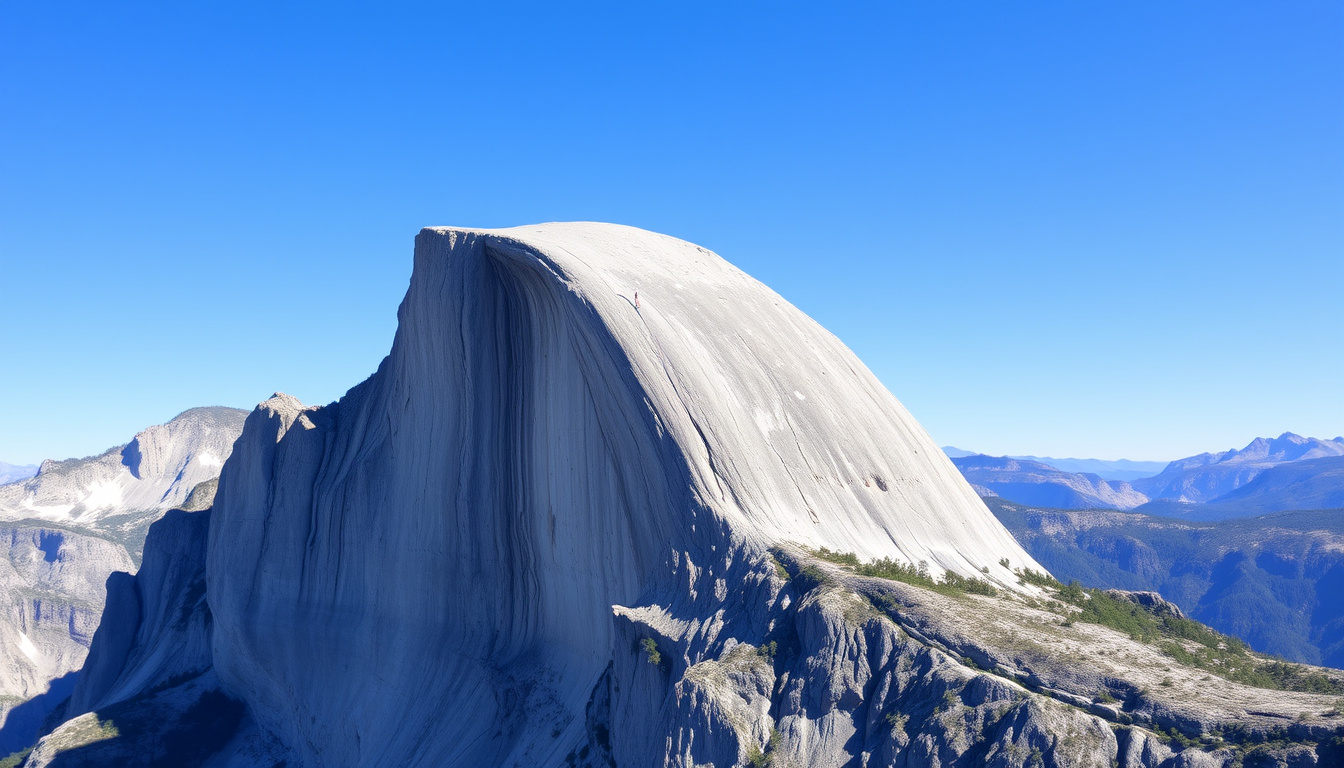
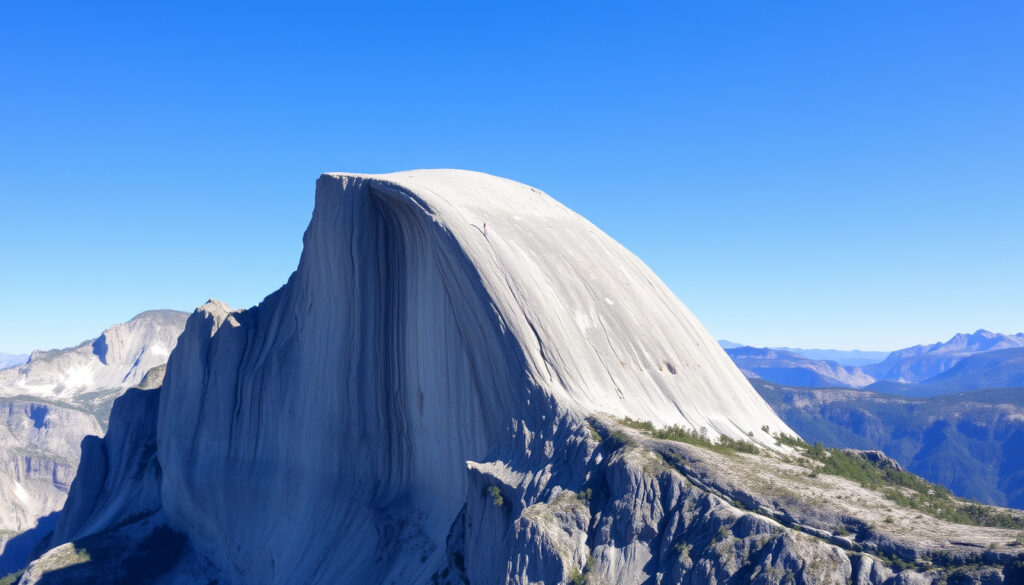
El Capitan is a granite monolith in Yosemite National Park and one of the world’s most famous big-wall climbing objectives. Known for its nearly vertical face, massive scale, and central role in modern climbing culture, it draws climbers and sightseers from around the world.
The wall rises about 3,000 feet (914 m) from base to summit along its tallest face and sits on the north side of Yosemite Valley near its western end. The summit reaches about 7,573 feet (2,308 m), a scale that helps explain its reputation as one of the largest exposed vertical granite faces on Earth.
El Capitan is also a viewing landmark, the star of an Academy Award-winning documentary, and the namesake of an exascale supercomputer. Because the name appears in several unrelated contexts, the distinctions are worth making clear.
What Is El Capitan?
El Capitan is widely described as the world’s largest granite monolith, or at least one of the largest exposed vertical granite faces on Earth. It has been a major destination for big-wall climbing for decades, supporting aid climbing, free climbing, and free solo climbing. It sits on the north side of Yosemite Valley near its western end, within Yosemite National Park. The National Park Service’s Yosemite page is the official reference for the park and its formations. For an encyclopedic overview, Wikipedia’s El Capitan entry provides detailed background, while Britannica’s profile adds historical and geological context.
- Height: about 3,000 ft (914 m) vertical face
- Location: Yosemite National Park, California
- First recorded ascent: The Nose, 1957 (Warren Harding)
- Famous climb: Alex Honnold free solo, 2017
Several points help frame what makes El Capitan so significant:
- The wall is visible from valley roads, which makes El Capitan one of the most accessible big walls to see, even without climbing.
- Honnold’s 2017 free solo remains one of the most celebrated athletic feats in climbing history.
- The commonly cited 3,000 ft (914 m) figure describes the face; some measurements differ.
- “North Face” may refer to the side of the rock or to the outdoor apparel brand.
- Hundreds of established routes exist; one source cites about 250.
- The same name is used for an exascale supercomputer and multiple restaurants.
| Attribute | Detail |
|---|---|
| Height | About 3,000 ft (914 m) vertical wall |
| Summit elevation | About 7,573 ft (2,308 m) |
| Location | Yosemite National Park, California, USA |
| Rock type | Granite |
| First recorded ascent | The Nose, completed by Warren Harding in 1957 (some sources cite 1958) |
| Notable free solo | Alex Honnold, 2017, documented in the film Free Solo |
| Established routes | Hundreds; one source counts about 250 |
| Typical roped ascent | Multiple days, using portaledges for sleeping |
How Did Alex Honnold Free Solo El Capitan?
Alex Honnold completed the first free solo ascent of El Capitan in June 2017. He climbed the wall without ropes, without gear, and without a partner. One widely cited account puts the time for the ascent at nearly four hours. ABC News covered the climb and the documentary team that recorded it.
What made the climb different?
Free soloing removes all protective equipment. Unlike a roped climb, where gear can stop a fall, a free solo leaves nothing between the climber and the rock. A detailed roundup of El Capitan facts emphasizes how different this is from speed climbing with ropes and support. The physical demands are extreme, and climbers pay close attention to conditioning. For a broader look at fitness baselines, Resting Heart Rate – Complete Guide To Normal Ranges is a useful reference.
How did Free Solo capture the story?
The ascent was documented in Free Solo, a 2018 documentary directed by Elizabeth Chai Vasarhelyi and Jimmy Chin. The film follows Honnold’s preparation and the climb itself, and it became the defining cultural portrait of El Capitan’s modern climbing era. The film went on to win the Academy Award for best documentary, a result reported by PlanetMountain. The Free Solo Wikipedia entry documents the production in detail, while National Geographic’s Free Solo page presents official materials from the film. The Guardian’s review appeared when the film reached theaters.
How does it compare to speed records?
Honnold is also tied to a very different El Capitan record. In 2018, he and Tommy Caldwell completed a rope-assisted speed ascent in 1 hour, 58 minutes, 7 seconds. That run used ropes and support, which is why it is not comparable to a free solo.
Honnold’s 2018 speed record with Tommy Caldwell (1:58:07) is often confused with his 2017 free solo. The speed record used ropes and a support team; the free solo used no protection of any kind.
How Does El Capitan Compare to Half Dome?
El Capitan and Half Dome are Yosemite’s two most recognizable granite formations, and comparisons between them are common. El Capitan is the larger big-wall climbing objective and the more vertical monolith of the two.
How do height and shape differ?
El Capitan rises about 3,000 feet (914 m) along its tallest face, with a summit elevation near 7,573 feet (2,308 m). Half Dome is equally iconic but is not the same kind of wall; sources describe El Capitan as the more vertical formation.
Which is better for hiking?
Half Dome is more famous as a hiking objective for non-climbers, while El Capitan is more strongly associated with technical wall climbing. El Capitan’s summit is generally reached by climbing, not by a normal trail. YosemiteHikes.com highlights El Capitan as a viewing landmark, and Yosemite.com’s El Capitan guide explains the main viewpoints and practical access.
Which is harder to climb?
For most people, El Capitan is in a separate category. Roped ascents take days, the walls are steep, and the commitment is far greater than the Half Dome hike.
What Are the Best Climbing Routes on El Capitan?
El Capitan has hundreds of established routes; one source counts about 250. The best-known line is The Nose, historically the classic route up the wall. Another famous line is the Dawn Wall, widely regarded as one of the hardest climbs in the world. A beginner’s guide from Climbing.com shares practical lessons for first-time wall climbers.
The Nose
The Nose is the historic heart of El Capitan climbing. Warren Harding completed the first recorded ascent in 1957, using fixed ropes and aid techniques in an effort that took about 45 days spread across a year. Some accounts date the finished climb to 1958. Before that ascent, the face was widely considered unclimbable.
The Dawn Wall
The Dawn Wall is regarded as one of the hardest climbs in the world. As a free-climbing line, it represents a modern benchmark for difficulty on El Capitan.
Wall ascents with ropes and protection often take multiple days. Climbers sleep on the cliff in portaledges, and the choice of line matters: about 250 routes exist, ranging from classic aid routes to modern free climbs.
Freerider
Freerider is a long free-climbing route on the wall; Honnold’s 2017 free solo followed this line. It is one of the most technically demanding free routes on the formation.
Viewing El Capitan without climbing
It is easy to appreciate El Capitan without ever putting on a harness. The monolith is visible from popular viewpoints and valley roads, and it has become one of Yosemite’s most photographed landmarks. Specific official webcam links and current trail-guide details are not consistently documented across the main references, so visitors should rely on official park channels for the latest information. For a very different kind of outdoor landmark, Roseberry Topping – Complete Walk Guide with Parking and Tips offers a walk-up summit and practical access advice.
What Other Things Are Named El Capitan?
Outside Yosemite, the name El Capitan has taken on other meanings. In high-performance computing, it belongs to one of the most powerful supercomputers planned in the United States. In the hospitality world, several restaurants share the name.
The El Capitan supercomputer
The El Capitan supercomputer is an exascale system at Lawrence Livermore National Laboratory, with deployment announced for the 2024–2025 period. Official materials describe it as part of the U.S. exascale computing initiative, with planned work in nuclear weapons simulations, climate modeling, and scientific research. Lawrence Livermore’s El Capitan announcement is the primary reference for specifications and timeline.
El Capitan restaurants
Multiple restaurants use the name El Capitan, including establishments in cities such as San Francisco. Because the name is shared, the exact location and menu depend on which business a review platform or search is describing.
A search for “El Capitan” may return the Yosemite granite wall, the Lawrence Livermore supercomputer, or a restaurant. They are unrelated; the context of the query usually decides which one is meant.
What Is the Timeline of El Capitan’s Key Events?
The recorded history of El Capitan is compact but significant, spanning a wall once considered unclimbable, a landmark free solo, and a supercomputer that carries the same name.
- — Warren Harding completes the first recorded ascent of El Capitan via The Nose, using fixed ropes and aid techniques after roughly 45 days of effort spread across a year. Some sources date the completed ascent to 1958.
- — Alex Honnold completes the first free solo ascent of El Capitan, climbing without ropes or gear.
- — The documentary Free Solo, directed by Elizabeth Chai Vasarhelyi and Jimmy Chin, is released and brings the climb to global audiences.
- — Honnold and Tommy Caldwell set a rope-assisted El Capitan speed record cited at 1 hour, 58 minutes, 7 seconds.
- — The El Capitan supercomputer is announced and deployed as an exascale system at Lawrence Livermore National Laboratory.
- — Recent guide and fact pages still describe El Capitan as a premier Yosemite landmark, citing its height, routes, and enduring climbing fame.
What Is Well Established About El Capitan and What Remains Unclear?
Most of El Capitan’s story is confirmed across multiple references. A handful of details, however, are cited differently depending on the source.
| Established information | Information that remains unclear |
|---|---|
| El Capitan is a granite monolith in Yosemite National Park and one of the world’s most famous big-wall climbing objectives. | The face is sometimes measured at about 2,900 ft rather than 3,000 ft, depending on the start and end points used. |
| Alex Honnold free soloed the wall in June 2017, and the climb is documented in the 2018 film Free Solo. | The completion year of the first ascent is given as 1957 in some accounts and 1958 in others. |
| Warren Harding made the first recorded ascent of The Nose using fixed ropes and aid techniques. | “El Capitan restaurant” can refer to several unrelated businesses with the same name. |
| The El Capitan supercomputer is an exascale system at Lawrence Livermore National Laboratory. | A specific official webcam link and current trail-guide details were not confirmed in the available references. |
Why Does El Capitan Matter Beyond Climbing?
Geologically, El Capitan belongs to the granite landscape of Yosemite Valley. Its sheer face and enormous scale place it among the largest exposed vertical granite faces on Earth, and it has been a visual anchor of the park for generations.
In Western climbing culture, the wall was long considered unclimbable. Warren Harding’s first ascent of The Nose changed that view, and El Capitan became a proving ground for big-wall techniques. The 2018 film Free Solo later carried that history well beyond climbing circles, winning an Academy Award and cementing the formation’s place in popular culture.
The name has also traveled into technology. The El Capitan supercomputer at Lawrence Livermore National Laboratory represents a major step in U.S. exascale computing, demonstrating how a single name can connect a natural landmark with advanced research infrastructure.
Which Sources Offer Reliable Information on El Capitan?
El Capitan appears across encyclopedic references, official park websites, and specialist climbing media. Wikipedia and Britannica contain detailed historical and geological summaries, while the National Park Service is the authoritative source for visiting Yosemite. Climbing magazines and the production pages for Free Solo add practical and cultural perspective.
The granite monolith rises 3,000 feet above the valley floor.
— NPS Yosemite
El Capitan is the world’s most accessible big wall, sitting just a thousand feet from the road in sunny California.
— Climbing.com
What Is the Bottom Line on El Capitan?
El Capitan is Yosemite’s defining granite wall: about 3,000 feet high, first climbed via The Nose in the late 1950s, and globally famous for Alex Honnold’s 2017 free solo and the documentary Free Solo. Its name now also belongs to a supercomputer and several restaurants, but the rock itself remains the draw — a vertical face that climbers spent decades trying to conquer and visitors still travel across the world to see.
What Else Do People Ask About El Capitan?
Is El Capitan the same as Half Dome?
No. El Capitan and Half Dome are two distinct granite formations in Yosemite Valley. El Capitan is a vertical monolith and a big-wall climbing objective, while Half Dome is better known as a hiking destination.
How long does it take to climb El Capitan?
Roped ascents of El Capitan often take multiple days, and climbers use portaledges to sleep on the wall. Experienced teams may finish The Nose in two to four days, while some sources say beginners need five to seven. Speed ascents have been done in under two hours.
Can I hike to the top of El Capitan?
Most visitors do not hike to the summit. The top is generally reached by technical climbing, and the standard experience is viewing the wall from Yosemite Valley. Some sources describe a strenuous backcountry trail, but it is not a normal walk-up route.
What is the El Capitan supercomputer used for?
The El Capitan supercomputer at Lawrence Livermore National Laboratory is built for exascale computing. Planned uses include nuclear weapons simulations, climate modeling, and complex scientific research.
Why was Alex Honnold’s free solo so significant?
Honnold climbed El Capitan without ropes, gear, or a partner in June 2017. Free soloing removes all protection, so any mistake is final. The feat was documented in the Academy Award-winning film Free Solo.
Where is the El Capitan restaurant?
Several restaurants use the name El Capitan, including establishments in cities such as San Francisco. Because the name is shared, the location and menu depend on which business a search or review is referring to.

Amelia Grant is Local Government Editor at RegionalReport.co.uk, covering council decisions, regional public policy, combined authorities, planning, housing and transport.