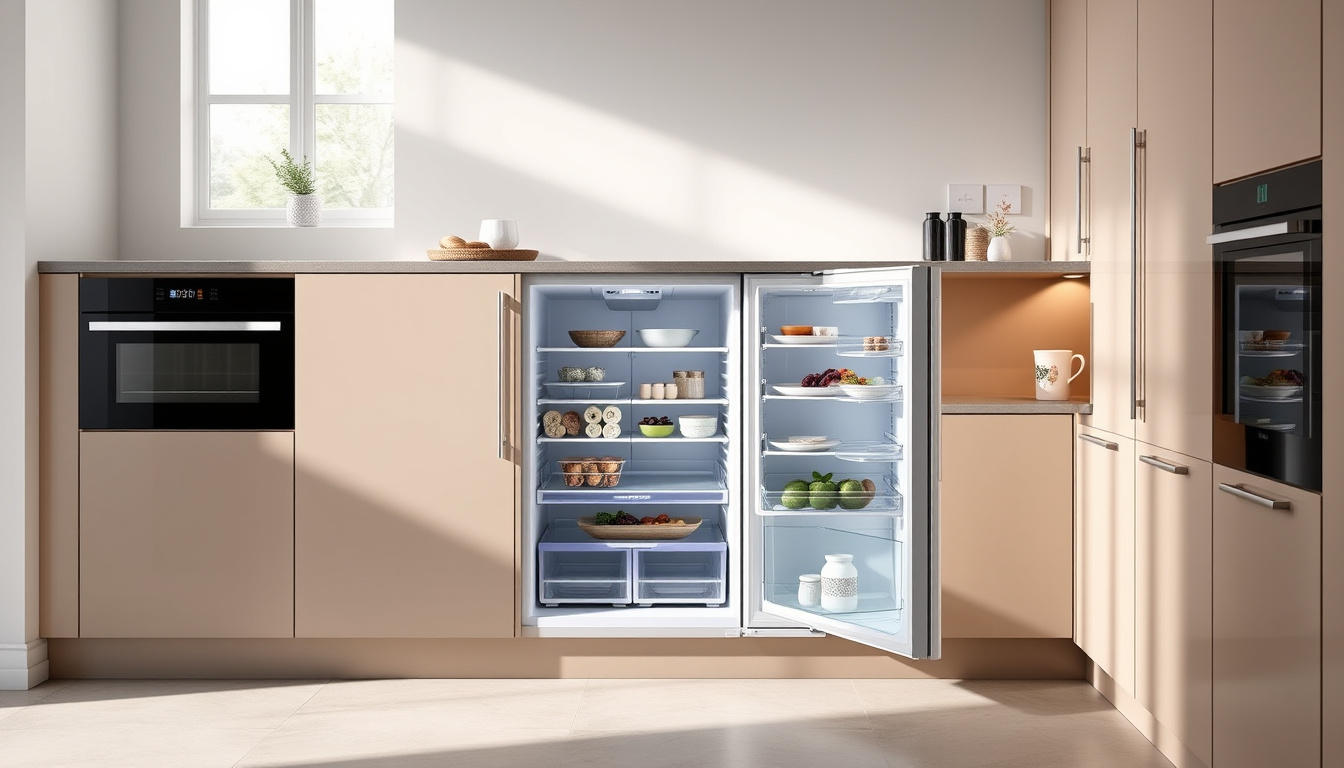
Integrated fridge freezers are designed to sit flush behind your kitchen cabinet doors, creating a seamless, built-in look that freestanding models cannot match. They require careful measurement and the correct split ratio — 50/50, 60/40, or 70/30 — to fit existing cabinetry. While generally more expensive than freestanding units due to the custom panel and hinge setup, they offer a streamlined aesthetic and, in many cases, comparable energy efficiency. Understanding the standard UK dimensions, hinge types, and key features is essential before making a purchase in 2025.
What is an Integrated Fridge Freezer and How Does It Differ from a Freestanding Model?
| What Is an Integrated Fridge Freezer? | Key Benefits Over Freestanding Models |
|---|---|
|
|
| Common Split Ratios (50/50, 60/40, 70/30) | Installation & Measurement Essentials |
|
|
Integrated models differ from freestanding ones in several practical ways. They are designed to be enclosed within a cabinet, which means they have specific ventilation needs and hinge systems. According to AO.com, integrated units are generally more expensive than freestanding because of the custom cabinet fit and door panel requirements. For many UK households, the clean, fitted look justifies the additional cost.
- Integrated fridge freezers hide behind cabinet doors, offering a seamless kitchen design.
- The split ratio determines fridge-to-freezer capacity; 50/50 is most common, but 70/30 offers more fridge space for fresh food lovers.
- Frost-free technology is now standard on most models, eliminating manual defrosting.
- Installation requires precise measurements; standard UK cabinets are 600 mm wide, 575 mm deep, with height varying (1770 mm or 820 mm for undercounter).
- Energy efficiency ratings (A to F) directly impact long-term running costs; look for C or better.
- Top brands like Bosch and AEG often offer longer warranties and better after-sales support.
| Field | Details |
|---|---|
| Average Price Range | £300 – £1,500 |
| Standard Width | 540–600 mm (often 596 mm) |
| Standard Depth | 545–575 mm (excluding door) |
| Standard Height | 1770 mm (full height) or 820 mm (undercounter) |
| Split Ratios Available | 50/50, 60/40, 70/30, 80/20 |
| Common Features | Frost Free, Sliding Door Hinge, Adjustable Shelves, LED Lighting |
| Energy Rating Range | A (best) to F (worst) – aim for C or higher |
| Noise Level | Typically 35–45 dB |
Which Split Ratio (50/50, 60/40, 70/30) Is Right for Your Household?
The split ratio refers to the percentage of total capacity allocated to the fridge versus the freezer. Choosing the wrong one can make it difficult to reline your kitchen cabinets if you replace the unit later. As Smeg explains, each ratio suits a different lifestyle. Here is a closer look at the three most common options.
50/50 Split
The 50/50 split gives equal storage to fridge and freezer sections. According to AO.com, it is best if you have equal amounts of fresh and frozen food. This is the most common split in UK kitchens and is a safe replacement choice if your existing unit uses it.
60/40 Split
The 60/40 split provides a slightly larger fridge while still offering ample freezer space. Smeg describes it as a good compromise for households that use frozen food regularly but also buy fresh produce weekly.
70/30 Split
The 70/30 split is designed for fresh food lovers. The fridge section is significantly larger, while the freezer is smaller. Smeg notes that this ratio is ideal if you buy lots of fresh produce and rarely freeze bulk items. However, a 70/30 unit may share the same shelf configuration as a 50/50 model in some brands, meaning you may gain little extra storage, as noted in online consumer discussions.
If you are replacing a like-for-like integrated unit, you must match the split type to ensure it fits your current cabinet shelves, warns AO.com. Installing a different split ratio may require new cabinet shelves or even a new housing.
How to Measure and Install an Integrated Fridge Freezer in Your Kitchen
Measuring Your Cabinet Aperture
Standard UK integrated fridge freezers are designed to fit a 60 cm wide cabinet. The internal aperture should measure approximately 54 cm wide, 54 cm deep, and 177 cm high for a full-height model, according to installation guides on YouTube. Always measure your internal aperture with a tape to confirm fit. For undercounter models, the height is typically 82 cm.
Hinge Types: Fixed vs Sliding
The hinge arrangement determines how the kitchen cabinet door attaches to the appliance. John Lewis explains that fixed hinges attach the cabinet door directly to the appliance door, so both move as one piece. Sliding hinges allow the appliance door to pivot inside the cabinet while the furniture door slides independently. Always verify which type your current kitchen uses before purchasing a replacement.
Installation Essentials
Professional installation is recommended for integrated models because of the precision required for door alignment and ventilation. As John Lewis notes, a 25 mm gap is required at the top, back, and sides if the unit is under a worktop to prevent overheating. AO.com offers installation services that can handle the cabinet fitting and hinge adjustment.
Key Features to Look For: Frost Free, Energy Efficiency, and More
Frost-Free Technology
Most modern integrated models come with frost-free (auto-defrost) technology. Village Domestic Supplies explains that this uses a fan to stop icy build-ups, meaning no manual defrosting is needed. This is now considered a standard feature rather than a premium upgrade.
Energy Efficiency
The energy rating label was updated in 2021, replacing the old A+++ to G scale. Look for models rated A (best) to F (worst) on the new scale; aim for C or higher. The UK government’s energy label guide provides official definitions for each rating. Lower energy consumption reduces both your carbon footprint and annual running costs.
The new energy label scale, introduced in March 2021, is stricter. A model that was rated A+++ on the old scale may now be rated B or C. Always check the current label to compare efficiently.
Noise Level
Integrated units often have better insulation because they sit inside a cabinet, which can reduce noise. Look for models with low decibel ratings, such as below 39 dB, as recommended by Village Domestic Supplies. Quieter compressors are becoming standard in 2025 models.
Fruit & Vegetable Drawers and Controlled Zones
A dedicated fruit and vegetable drawer keeps produce fresher and crisper for longer, according to Smeg. Some premium models also offer controlled temperature zones between -2°C and +3°C, ideal for storing fish, cheese, and meat at optimal conditions.
John Lewis specifies that a 25 mm ventilation gap is essential at the top, back, and sides of an integrated fridge freezer when installed under a worktop. Failure to provide adequate airflow can cause the compressor to overheat and fail prematurely.
Which Brands Offer the Most Reliable Integrated Fridge Freezers?
Reliability varies by brand, but several names consistently appear in UK consumer discussions. According to AskUK forum threads, Bosch and Siemens are considered reliable mid-to-high range options popular in the UK. Miele is cited as a premium, long-lasting brand but comes with a high price tag. Beko offers a cheaper entry point, though some users note variable reliability. Other brands such as AEG, Neff, Samsung, and Hisense also appear in the mid-range category.
For official specifications and warranty details, Bosch’s official website provides model-specific information. Independent reviews from organisations like Which? can also help compare temperature stability and noise levels across different brands.
How Much Does a Good Integrated Fridge Freezer Cost?
Prices vary significantly based on features and brand. Integrated models are generally more expensive than freestanding ones due to the custom cabinet fit, as noted by AO.com. Here is a breakdown of typical price tiers in the UK for 2025/2026:
| Brand Tier | Price Range (Approx.) | Recommended Brands |
|---|---|---|
| Budget | £187 – £400 | Beko, AEG (entry), Hisense |
| Mid-Range | £400 – £800 | Bosch, Siemens, Samsung, AEG, Neff |
| High-End | £800 – £4,999 | Miele, Liebherr, Smeg, Bosch (premium lines) |
When budgeting, consider not just the upfront cost but also energy consumption over 10+ years. The Energy Saving Trust offers guidance on running costs for refrigeration appliances.
Evolution of the Integrated Fridge Freezer
- 1990s: First built-in fridge freezers appear, often manually defrosted, with limited split ratio options.
- 2000s: Frost-free technology becomes widespread; split ratios diversify to 50/50, 60/40, and 70/30.
- 2010s: Energy efficiency regulations tighten; A+ and A++ ratings introduced.
- 2020s: Smart features (WiFi, touchscreens) appear on premium models; new EU/UK energy labels change ratings in 2021.
- 2025: Focus on sustainability, quieter compressors, and better integration with kitchen cabinetry.
Common Myths and Facts About Integrated Fridge Freezers
| Established Information | Information That Remains Unclear |
|---|---|
| Integrated fridge freezers are more expensive than freestanding models due to paneling and installation. | Whether they always have less storage space — many integrated models have similar net capacity to freestanding, but some trade-off exists for cabinet insulation. |
| Many integrated models achieve A or B energy ratings, so they can be very energy efficient. | Whether all integrated models are less efficient — efficiency depends on design and usage, not the form factor alone. |
| Frost-free technology is now standard in most integrated fridge freezers. | How long the compressor will last under heavy use — typical lifespan is 10–15 years, but individual results vary. |
Understanding Your Purchase: Market Context and Key Considerations
The UK market for integrated fridge freezers is dominated by European brands such as Bosch, Siemens, AEG, and Neff. Prices have risen modestly in recent years due to supply chain costs and new energy regulations. When buying, consider not just the upfront cost but also energy consumption over the appliance’s lifetime. Retailers like Currys, AO.com, and Marks Electrical provide installation services, which can be valuable for correct fitting. The choice between split ratios should be based on your household’s frozen vs fresh food usage — a 50/50 is balanced, 60/40 gives extra fridge space, and 70/30 is for those who rarely freeze. For small kitchens, undercounter integrated models (820 mm height) are available. Always measure your cabinet recess carefully and check for left/right door opening preference.
Expert Quotations and Verified Sources
Where possible, this guide relies on official brand specifications, energy label data from the European Commission and UK government, and independent test results from organisations like Which?. Smeg’s online guide explains the suitability of each split ratio, while AO.com provides practical replacement advice. John Lewis details hinge mechanisms, and Village Domestic Supplies outlines key features such as frost-free technology and noise levels. YouTube videos from appliance installers offer visual measurement guidance. All sources are linked for further reading.
Future Trends in Integrated Refrigeration
Look for more models with Wi-Fi connectivity for remote temperature control and fault alerts. Sustainability will drive use of recycled materials and natural refrigerants. AI-driven energy management may appear in premium models. Also, more flexible door hinge systems are expected to simplify installation. For a broader view of kitchen appliance choices, see our guide on How to Choose Kitchen Appliances.
Frequently Asked Questions
Can I use a freestanding fridge instead of an integrated one?
No, integrated fridge freezers are designed to fit into a cabinet and have ventilation systems designed for enclosed spaces. Freestanding models can overheat and fail if enclosed.
Do I need a special kitchen cabinet for an integrated fridge freezer?
Yes, most integrated models require a cabinet housing with a door that matches your kitchen fronts. Some manufacturers sell trim kits or adapters for sliding hinges.
How long does an integrated fridge freezer last?
Typically 10–15 years with proper maintenance. Regular cleaning of condenser coils and ensuring adequate ventilation can extend lifespan.
What is the difference between frost free and low frost?
Frost free (auto-defrost) uses a heating cycle to prevent ice buildup. Low frost only reduces ice formation but still requires manual defrosting periodically.
Can I buy an integrated fridge freezer with a water dispenser?
Yes, some premium models include a built-in water dispenser or ice maker, but they require a water line connection and usually take up freezer space.
Are there any integrated fridge freezers manufactured in the UK?
Most major brands are European (German, Swedish) or Korean. Some assembly may be in the UK, but full manufacturing is rare.

Amelia Grant is Local Government Editor at RegionalReport.co.uk, covering council decisions, regional public policy, combined authorities, planning, housing and transport.