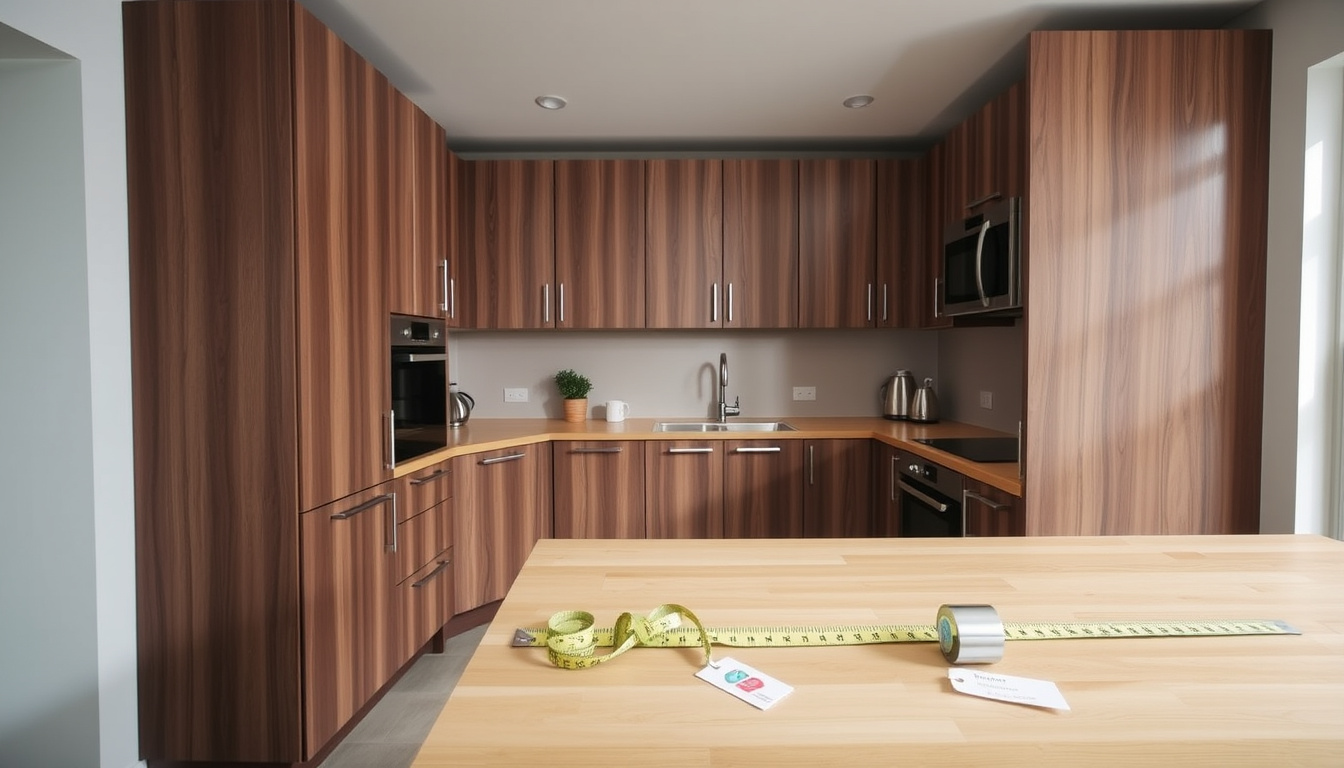
For UK homeowners planning a new kitchen in 2025, the choice of cupboards—or cabinets, as the terms are often used interchangeably—is one of the most consequential decisions. Sizes, materials, installation methods, and brand options vary widely, and the cost difference between a basic flat-pack setup and a fully fitted bespoke kitchen can run into tens of thousands of pounds. Understanding what you are buying, how it is built, and what you will actually pay requires a clear look at the numbers and the options on the market.
The typical fitted kitchen unit package in the UK is quoted between £1,500 and £3,000, with professional installation adding another £3,000 to £5,000 depending on complexity. Those figures, however, cover only the supply-and-fit baseline. Removal of old cabinetry, plumbing adjustments, and new worktops all sit outside that range and can push the final bill much higher.
This guide examines standard dimensions, real-world pricing, material trade-offs, installation steps, and the major UK retailers, so you can match your budget to the right product.
What are Standard Kitchen Cupboard Sizes?
Base units are typically 600mm deep, 720mm high (without worktop), wall units 720mm high, 300-600mm deep.
Ready‑to‑assemble kitchen cupboards range from £30-£150 per unit; fitted kitchens average £3,000-£15,000 total.
IKEA, B&Q, Wickes, Kitchen Warehouse, and The Cabinet Shop each offer different quality/price levels.
Flat‑pack installations are moderate skill level; require basic tools and careful leveling; professional fitting costs ~£1,000-£2,000.
When shopping for kitchen cupboards, knowing the standard measurements before you visit a retailer or place an order can prevent expensive mistakes. The UK kitchen industry works to broadly accepted dimensions, though some variation exists between brands.
- Most UK kitchen cupboard shoppers compare price between IKEA and B&Q, but independent specialists offer better customisation.
- Standard base cupboards (600x600x720mm) are the most common size; knowing measurements before shopping reduces costly mistakes.
- Material choice (MDF, plywood, solid wood) significantly affects durability and price; MDF is most common in mid‑range flat packs.
- DIY installation is common but requires precise leveling; about 30% of buyers still hire a professional fitter.
- Cabinet prices are often quoted by linear foot, especially for custom or semi-custom units.
- Custom cabinetry is built to exact kitchen dimensions and commands the highest price.
- Layout complexity increases labour time and installation cost substantially.
| Specification | Typical Value |
|---|---|
| Standard base unit width | 300, 400, 600, 800, 900, 1000 mm |
| Standard base unit depth | 560-600 mm (without worktop) |
| Standard base unit height | 720 mm (without worktop / legs) |
| Standard wall unit height | 720 mm (adjustable up to 900 mm) |
| Most common door style | Slab (flat) or Shaker |
| Average cost per unit (RTA) | £40 – £120 |
| Average cost per unit (assembled) | £100 – £300 |
| Common materials | MDF, plywood, particleboard with melamine finish |
| Warranty typical | 5-10 years for cabinets, 2 years for doors |
How Much Do Kitchen Cupboards Cost? (UK Pricing Guide)
Cost is the primary concern for most buyers. The total spend depends on cabinet type, material, brand, and whether you install yourself or hire a professional. One UK pricing guide puts standard fitted kitchen units at £1,500–£3,000 for a complete installation package, with professional labour often running £50–£70 per hour.
What is the cheapest way to fit a kitchen?
The most affordable route is ready-to-assemble (RTA) flat-pack cupboards from a mass-market retailer. IKEA kitchen cabinets are generally the most affordable option in UK brand comparisons, with base cabinets as low as £51. B&Q fitted kitchen ranges start around £979–£1,196 for small unit packages, while Wren offers entry-level flat-pack packages below £1,000 for small kitchens. Removal of existing cabinetry adds roughly £500–£2,000 if demolition is needed.
How much does it cost to replace kitchen cupboard fronts?
Replacing only doors and drawer fronts costs roughly 40–60% of a full new kitchen. Expect £200–£600 per door depending on material and style. This is a common approach for homeowners who want a refreshed look without the expense and disruption of a full refit.
How much does a typical kitchen cabinet cost in the UK?
Average total kitchen cabinet spend by brand ranges from about £2,500–£7,500 for stock cabinets installed, and £15,000–£30,000+ for custom cabinetry. Supply costs are only part of the picture: installation normally adds £3,000–£5,000, and separate trades for plumbing, electrics, tiling, and flooring can increase the total substantially.
Magnet entry-range kitchens start at about £2,487, rising to £7,676 for higher ranges, excluding installation. IKEA base cabinets are priced individually, typically £51–£170 per unit. Homebase kitchens are often quoted around £2,000–£6,000 excluding installation. Howdens, widely used in trade channels, reports kitchen costs around £5,000–£15,000 depending on specification.
What is the Best Material for Kitchen Cupboards?
Material choice is one of the biggest drivers of both cost and durability. Each material offers a different balance of price, appearance, and longevity.
Are flat pack kitchen cupboards good quality?
Quality varies significantly by brand and material. IKEA’s particleboard cabinets are durable for most homes, while B&Q and Wickes offer MDF options. Solid wood flat-packs are rare. For high-traffic kitchens, upgrading to plywood carcasses provides better rigidity and screw-holding strength. B&Q kitchen cupboards are commonly cited for variety in design at budget-to-mid-range price points.
MDF vs plywood kitchen cabinets – which is better?
MDF (medium-density fibreboard) is the most common material for mid-range flat-pack cabinets because it is stable and easy to machine. It costs roughly £100–£300 per linear foot in one UK price guide, or £300–£400 per linear foot depending on specification. Plywood with veneer is more expensive at £250–£400 per linear foot but offers better rigidity and durability, particularly in damp conditions. Solid wood is the premium choice at £300–£600 per linear foot in one guide, and £400–£900 per linear foot in another, depending on timber and finish.
What are the different types of kitchen cupboard doors?
Door styles range from slab (flat) and Shaker to raised-panel, glass-front, and bespoke designs. The door material and finish—laminate, thermofoil, painted MDF, or solid wood—affect both cost and maintenance requirements. Laminate doors cost about £200–£350 per linear foot and are easy to clean, while thermofoil doors run £180–£280 per linear foot and are common for smooth contemporary looks.
Prices for kitchen cupboards are often quoted per linear foot, especially for custom and semi-custom units. Always confirm whether quoted prices include worktops, handles, soft-close hardware, delivery, and VAT. Material choice can shift the final bill by thousands of pounds on a medium-sized kitchen.
How to Install Kitchen Cupboards (DIY Guide)
Installing kitchen cupboards yourself is feasible for a competent DIYer, but it requires careful planning, the right tools, and patience with leveling.
Can I install kitchen cupboards myself?
Yes, flat-pack installations are designed for self-assembly, but the difficulty is moderate. About 30% of buyers still hire a professional fitter. Professional fitting costs roughly £1,000–£2,000 for a standard kitchen, and many homeowners find the time and precision required justify the expense.
What tools do I need to fit kitchen units?
Basic tools include a tape measure, spirit level, drill, screwdriver, clamps, jigsaw, silicone sealant, and wall fixings. For wall cabinets, a stud finder is essential, and a helper is strongly recommended for lifting and holding units in place.
How to fix kitchen cupboard doors that won’t close
Adjust the hinge screws with a screwdriver to move the door in or out. If doors are binding, check whether the cabinet box is level. Hinges can also be replaced easily if adjustment fails. This is a common issue after installation as the cabinet frame settles.
Install base cabinets and worktop first (2–3 days), then wall cabinets (1 day). Fit doors and adjust hinges afterward, and add handles, fillers, and trim on the final day. This sequence prevents damage to doors during the heavy fitting work.
How Long Does It Take to Install Kitchen Cupboards?
A typical kitchen cupboard installation takes 7–14 days from delivery to completion when carried out by a professional. DIY timelines can be longer, especially for first-time installers.
- Measure your kitchen accurately (allow 1–2 days)
- Choose style, colour, and material (1–2 weeks research)
- Order kitchen cupboards (2–6 weeks delivery for custom, 1–2 weeks for stock)
- Prepare the room – remove old kitchen, level walls (1–2 days)
- Install base cabinets and worktop (2–3 days)
- Install wall cabinets (1 day)
- Fit doors and adjust hinges (1 day)
- Add handles, fillers, and trim (1 day)
What Is Certain and What Remains Uncertain About Kitchen Cupboard Costs?
| Established Information | Information That Remains Unclear |
|---|---|
| Standard sizes are defined by UK kitchen industry (e.g., 600mm base unit width) | Final prices vary by chosen accessories, handles, and worktop material |
| IKEA, B&Q, Wickes are major national retailers with fixed pricing | Installation difficulty depends on wall condition and plumbing location |
| Flat‑pack cupboards require self‑assembly | Custom cupboard lead times vary significantly by manufacturer |
| — | Trend colours change year to year; 2025 trends are not yet fully confirmed |
How Has the UK Kitchen Cupboard Market Evolved?
The UK kitchen cupboard market is dominated by flat-pack giants such as IKEA, B&Q, and Wickes, but bespoke suppliers like The Cabinet Shop cater to those needing exact dimensions. Consumer research shows price and durability remain the top priorities, with MDF the most widely used material for mid-range products. The rise of online ordering has reduced showroom visits, but accurate self-measurement is critical to avoid returns. Wickes kitchen units are positioned as trade-friendly, value-oriented options, while Kitchen Warehouse UK offers customisation for buyers who want more than off-the-shelf sizes.
DIY popularity continues to grow, driven by online video tutorials and affordable tool hire. At the same time, premium brands report steady demand for custom joinery, with the highest-spec kitchens running well above £30,000 for fully bespoke installations.
What Do Industry Experts and Retailers Say?
“Standard kitchen base units are 600mm wide and 720mm high, but always measure your space carefully.”
— UK Kitchen Industry Standards (NKBA guidelines)
“IKEA kitchen cabinets come with a 25‑year warranty, making them a popular choice for budget‑conscious buyers.”
— IKEA UK website (product page)
“MDF is the most common material for flat‑pack cabinets because it is stable and easy to machine.”
— DIY.com product descriptions
What Should You Know Before Ordering Kitchen Cupboards?
Before committing to a purchase, measure the room carefully, confirm wall lengths and ceiling height, and decide whether you want stock, semi-custom, or custom cupboards. Compare quotes on the same basis—cabinet supply only, supply and fit, or full renovation—and check whether prices include worktops, handles, soft-close hardware, delivery, and VAT. Ask about warranty length and after-sales support. If buying flat-pack, confirm assembly and fitting responsibility before ordering. The Average cost of kitchen units – pricing guide for every budget provides a detailed reference for expected spend, and the Best fitted kitchen brands and suppliers compared guide offers side-by-side evaluations of the major UK retailers.
Frequently Asked Questions
What is the difference between kitchen cabinets and cupboards?
In the UK, the terms are used interchangeably. ‘Cabinets’ often refers to the entire unit (carcass + door), while ‘cupboards’ can imply the storage space inside. Both terms appear on retailer websites.
Are flat pack kitchen cupboards good quality?
Quality varies by brand. IKEA’s particleboard cabinets are durable for most homes, while B&Q and Wickes offer MDF options. Solid wood flat-packs are rare. For high-traffic kitchens, consider upgrading to plywood carcasses.
Can I paint kitchen cupboards?
Yes, laminated surfaces need proper sanding and primer. MDF doors accept paint well. Many people repaint rather than replace to save money. Use a high-quality cabinet paint and follow preparation steps.
How much does it cost to replace kitchen cupboard fronts?
Replacing only doors and drawer fronts costs roughly 40–60% of a full new kitchen. Expect £200–£600 per door depending on material and style.
What tools do I need to fit kitchen units?
Basic tools: tape measure, spirit level, drill, screwdriver, clamps, jigsaw, silicone sealant, and wall fixings. For wall cabinets, you’ll need a stud finder and possibly a helper.
How to fix kitchen cupboard doors that won’t close?
Adjust the hinge screws with a screwdriver to move the door in or out. If doors are binding, check if the cabinet box is level. Hinges can also be replaced easily.
Kitchen cupboards vs open shelving – which is better?
Cupboards hide clutter and protect from dust; open shelving creates an airy feel but requires constant tidying. Many modern kitchens use a mix of both.
How deep is a standard kitchen base unit?
Standard base units are 560–600mm deep without a worktop. The depth includes the cabinet box only; the worktop overhang adds additional depth.
What height are wall cupboards?
Standard wall units are 720mm high, though some ranges offer adjustable heights up to 900mm. Depth typically ranges from 300mm to 600mm.
Should I buy from IKEA or B&Q for kitchen cupboards?
IKEA is generally the most affordable option with a 25-year warranty. B&Q offers more variety in design and budget-to-mid-range choices. Your decision should factor in local availability, delivery times, and whether you need design services.

Henry Wallace is Managing Editor at RegionalReport.co.uk, running the daily news list, the regional publishing schedule and newsroom workflow.