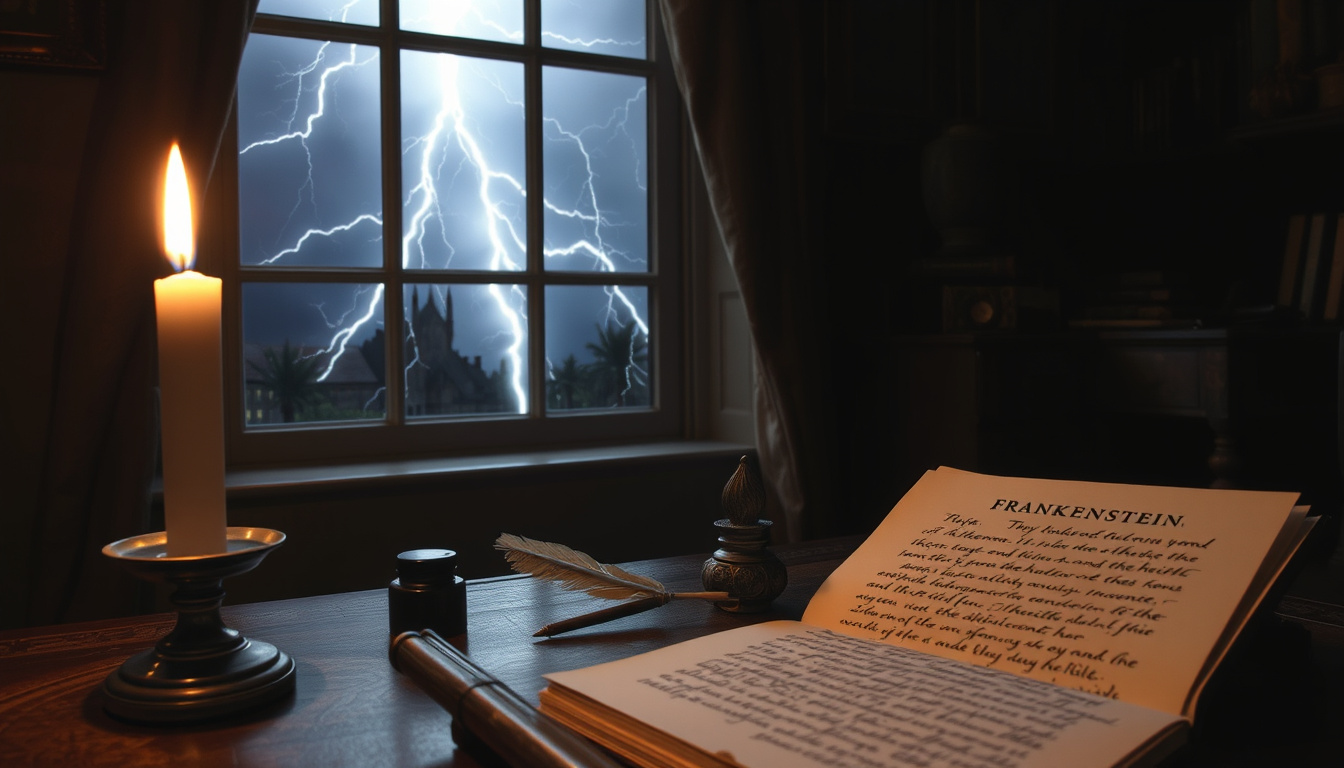
Mary Shelley was an English novelist best known for Frankenstein; or, The Modern Prometheus (1818), a novel widely credited as an early work of science fiction and one of the most enduring Gothic horror classics. According to Encyclopaedia Britannica, she was born Mary Wollstonecraft Godwin in London on 30 August 1797 and died in London on 1 February 1851. She was the daughter of Mary Wollstonecraft, a pioneering feminist writer, and William Godwin, a political philosopher and novelist. Sources describe her upbringing as shaped by radical intellectual circles and by the early death of her mother.
She later married the poet Percy Bysshe Shelley and lived in Italy for several years. After his death, she built a career as a novelist, editor, and travel writer, though for many years her own reputation was overshadowed by his.
Who Was Mary Shelley?
Who: Mary Wollstonecraft Shelley, English novelist, born 30 August 1797
What: Author of Frankenstein; or, The Modern Prometheus
When: 1797–1851; major work published 1818
Why it matters: Helped define Gothic fiction and is often credited as a foundational text of science fiction
Key insights
- Mary Shelley was only 18 when the idea for Frankenstein came to her in 1816.
- Frankenstein was published anonymously in 1818 and became a landmark of Gothic and Romantic-era fiction.
- Her parents, Mary Wollstonecraft and William Godwin, placed her in a radical intellectual tradition.
- After Percy Bysshe Shelley died, Mary edited and promoted his poetry.
- Her later novels including The Last Man and Valperga are less famous today but remain historically important.
Snapshot: Mary Shelley by the Numbers
| Name | Mary Wollstonecraft Shelley (née Godwin) |
| Born | 30 August 1797, London, England |
| Parents | Mary Wollstonecraft and William Godwin |
| Defining work | Frankenstein; or, The Modern Prometheus (1818) |
| Other works | Valperga, The Last Man, Falkner, short stories, essays, and travel writing |
The Poetry Foundation biography places her within a family of radical thinkers. Her mother’s feminist writing and her father’s political philosophy shaped the intellectual world into which she was born.
What Is Mary Shelley Famous For?
Mary Shelley is known above all for Frankenstein. The novel was first published in January 1818, with a revised edition in 1831. Literary histories credit her with combining scientific ideas and Gothic fiction in a way that helped define the genre.
Who wrote Frankenstein?
Mary Shelley wrote Frankenstein. She began it during a summer stay near Lake Geneva in 1816, when she was part of a literary circle including Percy Shelley and Lord Byron. One source describes the novel as arising from a “waking dream,” and another says she was inspired during a rainy summer in Switzerland.
Mary Shelley later described the novel’s origin in her 1831 introduction to Frankenstein. That account has become central to popular retellings of the novel’s creation.
What is Frankenstein about?
The novel explores ambition, responsibility, and the consequences of unchecked creation. It is often read as an early science-fiction-like cautionary tale.
Why is Frankenstein important?
Frankenstein is often described as a defining Gothic novel and a foundational text of science fiction. Biography.com says Mary Shelley is frequently called the “Mother of Science Fiction.” The novel remains widely adapted and referenced in popular culture.
What Books Did Mary Shelley Write?
Beyond Frankenstein, Mary Shelley wrote six other novels, plus short stories, essays, travel writing, biographies, and mythological dramas. The British Library notes that she built a successful career in fiction, travel, and biography, while also editing and championing Percy Shelley’s work.
What are Mary Shelley’s most famous works?
After Frankenstein, her most frequently cited works include Valperga, The Last Man, and Falkner. These novels reflect her interest in history, politics, and speculative ideas.
What did Mary Shelley write after Frankenstein?
She continued to publish across several genres, including historical fiction, speculative fiction, and travel writing. Her later work often engaged with questions of power, knowledge, and social change.
Mary Shelley’s career included editing and promoting Percy Bysshe Shelley’s poetry after his death. Several sources describe her as a significant author in her own right whose work was long viewed through her husband’s shadow.
Who Was Mary Shelley’s Husband?
Mary Shelley’s husband was the poet Percy Bysshe Shelley. According to Penguin Random House, she met him in 1814, eloped with him soon after, and married him in December 1816 after his first wife had died. The couple lived in Italy from 1818 to 1822.
Did Mary Shelley have children?
She had four children, but only her son Percy Florence Shelley survived to adulthood. The deaths of her other children were among the personal losses she faced throughout her life. She later edited and promoted her husband’s works.
How Did Mary Shelley Die?
Mary Shelley died in Chester Square, London, on 1 February 1851, at the age of 53. Her death is generally reported as being caused by a suspected brain tumor or brain cancer, though the exact medical cause is not fully certain.
The precise cause of Mary Shelley’s death has not been definitively established. Most biographical accounts rely on later recollections, and medical knowledge in the mid-nineteenth century was far less advanced than it is today.
How Has Mary Shelley Been Portrayed On Screen?
Frankenstein continues to inspire film adaptations and related productions. The novel’s imagery and themes have proved remarkably adaptable, from stage plays to horror cinema.
Is there a 2017 Mary Shelley movie?
A 2017 biographical film titled Mary Shelley dramatizes her life and her relationship with Percy Bysshe Shelley. The film’s IMDb page lists cast, crew, and release details. Because it is a dramatized biopic, it should not be read as a documentary.
For a memorable screen performance connected to the Frankenstein tradition, see Peter Boyle – Iconic Roles From Young Frankenstein to ….
What Were the Key Dates in Mary Shelley’s Life?
- – Mary Wollstonecraft Godwin was born in London on 30 August.
- – Her mother, Mary Wollstonecraft, died shortly after her birth.
- – Mary spent the summer at Lake Geneva, where the idea for Frankenstein emerged.
- – Frankenstein; or, The Modern Prometheus was published anonymously.
- – The Last Man was published.
- – A revised edition of Frankenstein was published with a new introduction by Mary Shelley.
- – Mary Shelley died in London on 1 February.
Some facts about Mary Shelley’s life are firmly established, while others rest on later accounts or medical uncertainty.
| Established | Less certain / interpreted |
| Mary Shelley was born in 1797 and died in 1851. | The exact medical cause of her death is not fully certain. |
| She wrote Frankenstein, first published in 1818. | The 2017 film Mary Shelley dramatizes her life and should not be read as a documentary. |
| She married Percy Bysshe Shelley in 1816. | |
| She was the daughter of Mary Wollstonecraft and William Godwin. |
Why Is Mary Shelley Important?
Mary Shelley’s importance extends beyond the plot of her most famous novel. Frankenstein emerged during a period of rapid scientific discovery and political upheaval. Her writing responded to the questions of her time while also reaching beyond them.
The novel is often read as a warning about creation and responsibility. Mary Shelley wrote within a circle of major Romantic-era thinkers, and her mother, Mary Wollstonecraft, was a pioneering feminist writer. These influences shaped both the novel and her wider body of work.
Over time, Frankenstein has become a modern cultural myth. The Wikipedia biography of Mary Shelley documents the breadth of her influence and the ongoing adaptation of her work.
Readers interested in the mythic patterns behind stories like Frankenstein can find a useful starting point in Carl Jung – Biography, Theory, Archetypes.
Which Sources Best Document Mary Shelley’s Life and Works?
The full text of Frankenstein is available in the public domain. Project Gutenberg offers the complete novel for free reading online. Mary Shelley’s 1831 introduction to the revised edition describes the novel’s origin and is frequently quoted by biographers.
Institutional sources such as Encyclopaedia Britannica offer verified biographical summaries, and Poetry Foundation profile adds literary context. Together these sources provide a reliable starting point for research.
“Mother of Science Fiction.”
Biography.com on Mary Shelley
The novel arose from a “waking dream.”
Popular accounts of the origin of Frankenstein
Why Does Mary Shelley’s Legacy Endure?
Mary Shelley’s legacy endures because Frankenstein continues to speak to questions about creation, responsibility, and ambition. She helped define Gothic fiction, shaped the early language of science fiction, and left behind a substantial body of work that extends well beyond her most famous novel.
Frequently Asked Questions About Mary Shelley
Why is Frankenstein considered important?
It is often described as a defining Gothic novel and an early work of science fiction.
Did Mary Shelley write any other books besides Frankenstein?
Yes. She wrote six other novels, including Valperga, The Last Man, and Falkner, as well as short stories, essays, and travel writing.
How old was Mary Shelley when she wrote Frankenstein?
She was 18 when the idea came to her in 1816. The novel was published in 1818, when she was 20.
What happened to Mary Shelley’s children?
Only her son Percy Florence Shelley survived to adulthood.
Is the 2017 Mary Shelley movie accurate?
It is a dramatized biopic, not a documentary. It is useful as an entry point but should not be treated as fully literal history.

Sophie Kendall is Culture & Communities Editor at RegionalReport.co.uk, covering community stories, arts, culture, festivals, local events and heritage.