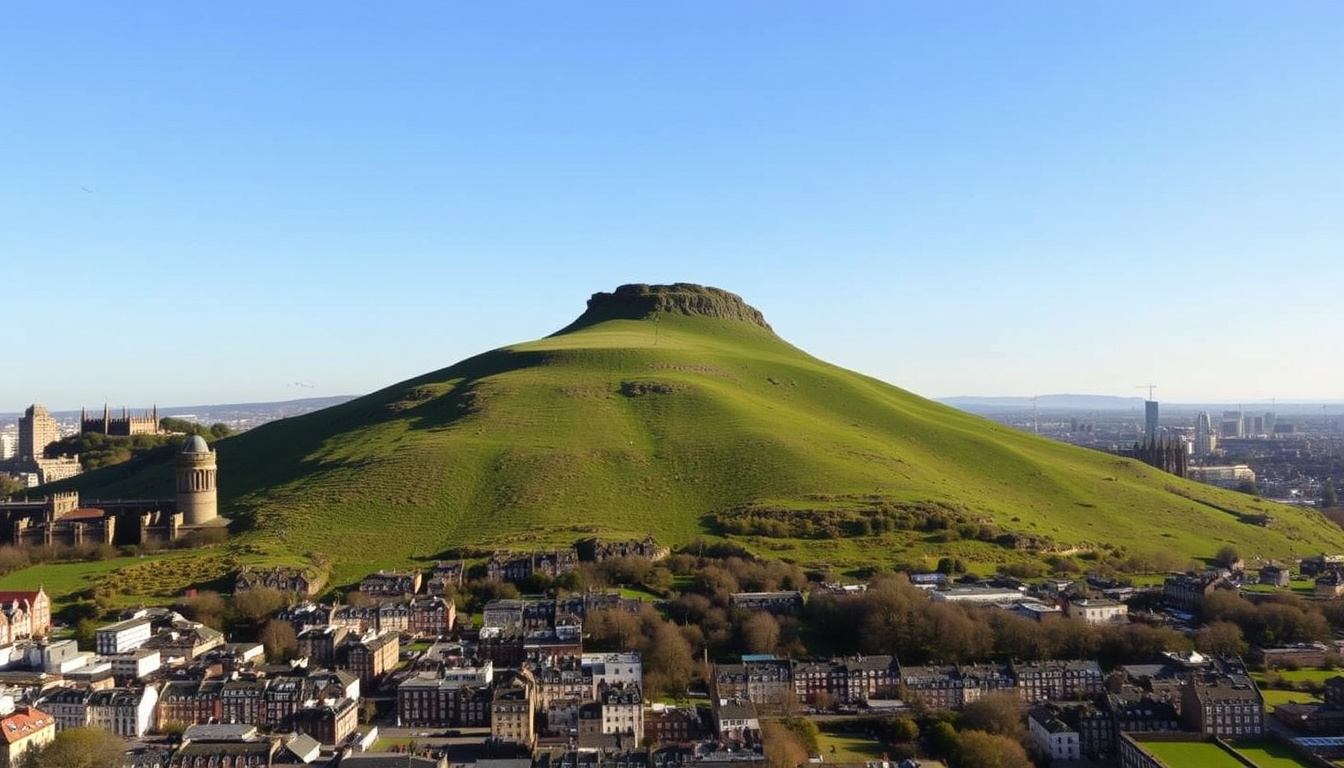
Arthur’s Seat: Edinburgh’s Ancient Volcano and Scenic Hike
Rising dramatically from Holyrood Park, Arthur’s Seat is one of Edinburgh’s most iconic landmarks. This ancient, extinct volcano offers a rewarding hike in the heart of the city, with panoramic views and a deep geological history that spans hundreds of millions of years.
The hill is the main peak of a group of hills in Holyrood Park, located about a mile east of Edinburgh Castle. Reaching 251 metres (823 ft) above sea level, it is a popular destination for both locals and visitors seeking a quick escape into nature without leaving the city limits.
Managed by Historic Environment Scotland, the park and its centrepiece are free to enter and open year-round. The site is not only a natural haven but also one of the most studied ancient volcanoes in the world.
Why Is It Called Arthur’s Seat?
The most widely accepted explanation traces the name to Scottish Gaelic. The phrase Suidhe Artair translates to “Arthur’s Seat,” likely referring to a legendary or historical figure named Arthur. Contrary to popular belief, it is unrelated to the Roman emperor or the medieval King Arthur of Camelot, though local folklore sometimes links it to Arthurian legend.
Some scholars suggest the name may derive from Àrd Seus (Height of Arrows) or Ard-na-Saighead, but the Gaelic etymology remains the strongest theory. The name first appears in written records from the 16th century, though the hill itself has been a prominent feature of Edinburgh’s landscape for much longer.
Who Is Arthur in Arthur’s Seat?
The identity of the namesake Arthur is not confirmed. He could be a local chieftain, a figure from early chroniclers, or a product of folklore. There is no definitive historical evidence linking the site to a specific person named Arthur. The name likely emerged from local storytelling and early map-making traditions.
The Gaelic origin Suidhe Artair remains the leading theory among historians, but no single explanation is universally accepted. The true source of the name may never be known with full certainty.
Where Is Arthur’s Seat and How to Get There?
Arthur’s Seat sits within Holyrood Park, just east of Edinburgh’s city centre. The park’s main entrance is off Queen’s Drive, a road that circles the hill and provides access to multiple starting points. The location is roughly 1.6 km (one mile) east of Edinburgh Castle.
Walking Routes
The most accessible ascent is from the east, via a grassy slope that rises above Dunsapie Loch. This is the easiest and most popular route. You can climb from almost any direction, but the eastern approach is recommended for those seeking a gentler gradient.
A direct climb takes between 30 and 60 minutes. For those who want a longer experience, the full circuit of Holyrood Park can take 1.5 to 2 hours. Along the way, you will pass Salisbury Crags, Whinny Hill, and Queen’s Drive.
Radical Road
The Radical Road is a historic track along the top of the slope under Salisbury Crags. It was paved after the Radical War of 1820, using labour from unemployed weavers as work relief. The path has been closed since 2018 due to a 50-ton rockfall from the cliffs above. Visitors are advised to exercise caution in this area and respect all closure signs.
Arthur’s Seat at a Glance
Key Insights
- Arthur’s Seat is the remains of an ancient volcano that erupted around 350 million years ago.
- Despite its name, there is no confirmed link to King Arthur; the name may derive from Scottish Gaelic Àrd Seus meaning “Height of Arrows”.
- The summit offers panoramic views of Edinburgh, Firth of Forth, and beyond.
- Arthur’s Seat is part of Holyrood Park, which is managed by Historic Environment Scotland and is free to enter.
Key Facts About Arthur’s Seat
| Attribute | Value |
|---|---|
| Elevation | 251 m (823 ft) |
| Prominence | 186 m (610 ft) |
| Geological Age | ~350 million years (Carboniferous) |
| Volcanic Type | Extinct volcano (intrusion remains) |
| First Known Name | Recorded as “Arthur’s Seat” in 18th-century maps |
| Location | Holyrood Park, Edinburgh (55°56′39″N 3°09′43″W) |
| Managed By | Historic Environment Scotland |
| OS Grid Reference | NT 27494 73144 |
How Tall Is Arthur’s Seat and Is It a Mountain?
Arthur’s Seat stands at 251 metres (823 ft) above sea level. Its prominence — a measure of how much it rises above the surrounding terrain — is 186 metres (610 ft). Despite its imposing presence, it is not classified as a mountain. In the UK, a landform must be at least 600 metres (2,000 ft) high to be considered a mountain. Arthur’s Seat therefore remains a hill, though one with an extraordinary geological origin.
The height is consistent across all authoritative sources, including Wikipedia and the British Geological Survey. The summit elevation is sometimes given as 250.5 m (822 ft) in older surveys, but the modern accepted figure is 251 m (823 ft).
Arthur’s Seat is taller than other popular Edinburgh viewpoints such as Calton Hill (about 100 m), but smaller than true mountains like Ben Nevis (1,345 m). It offers one of the best height-to-effort ratios in the city.
What Is the Geological History of Arthur’s Seat?
Arthur’s Seat is an extinct volcano that erupted approximately 340–342 million years ago during the Early Carboniferous period. At that time, Scotland was located near the equator, and the landscape was vastly different from today. The volcano was a composite or stratovolcano with five distinct vents that produced separate lava flows.
Volcanic Structure and Erosion
The volcano originally built a low cone up to about 200 metres higher than the current summit. Over millions of years, erosion reduced it to its present form. Lava flows cooled into black basalt full of gas bubbles, while explosive eruptions created red agglomerate rock that can still be seen on the slopes.
About 15 million years after the main volcanic activity, magma intruded underground to form dolerite. This later intrusion created the dramatic cliffs of Salisbury Crags, which are not part of the original volcano but a separate geological event.
Glacial Shaping
Over the last 2 million years, ice sheets moving from the west eroded the softer rock layers, exposing the hard crags and shaping Holyrood Park’s current landscape. This glacial action carved the distinctive profile that makes Arthur’s Seat so recognisable today.
Scientific Significance
In the late 18th century, James Hutton — often called the father of modern geology — studied the rocks at Salisbury Crags and Arthur’s Seat. He proved that igneous rocks had intruded older sedimentary layers, supporting his revolutionary theory that the Earth was much older than previously believed. Hutton’s Section at Salisbury Crags became a key site in the development of modern geological theory.
Today, the site is one of the most studied ancient volcanoes in the world. Visitors can literally walk into the heart of the extinct volcano and stand on its original crater summit, a rare experience in geological tourism.
The geological processes that shaped Arthur’s Seat are still active at a very slow pace. Rockfalls, like the 50-ton event on the Radical Road in 2018, are a reminder that the landscape is not entirely static. Always stay on marked paths and heed official closure signs.
What Are the Latest News and Updates About Arthur’s Seat?
Arthur’s Seat remains a stable natural attraction. The most significant recent development is the ongoing closure of the Radical Road due to the 2018 rockfall. There is no confirmed date for its reopening. Other paths in Holyrood Park remain open and well-maintained.
For the most current information on trail conditions, weather alerts, and seasonal access, check the Historic Environment Scotland website. The UK Met Office provides up-to-date weather forecasts specific to the area, which is useful for planning a visit.
Future developments may include trail improvements, visitor information updates, and seasonal events in Holyrood Park. No major structural changes are anticipated in the near term.
More information on the park’s management is available from the Edinburgh Council and the detailed Walkhighlands route guide.
Timeline: Formation and History of Arthur’s Seat
- ~350 million years ago – Volcanic activity during the Carboniferous period creates the basic geological structure of Arthur’s Seat.
- ~2,000 years ago – Iron Age hillforts built on the hill (one of four in Holyrood Park).
- 12th century – Holyrood Abbey established at the base; parkland used as royal hunting ground.
- 16th century – First known written references to “Arthur’s Seat” appear in local records.
- 19th century – Landscaping of Holyrood Park by Prince Albert; popular walking destination.
- 1847 – Robert Louis Stevenson writes about Arthur’s Seat in his essays.
- 20th century – Holyrood Park becomes a public park under state management.
- Present – Arthur’s Seat remains a major tourist attraction and natural landmark in Edinburgh.
Certainty vs. Uncertainty: What We Know and What Is Debated
| Established Information | Information That Remains Unclear |
|---|---|
| Arthur’s Seat is an extinct volcano, not a mountain (its height is below the 600m mountain classification threshold). | The origin of the name “Arthur’s Seat” is unclear. Theories include a connection to King Arthur (though lacking historical evidence) or derivation from Scottish Gaelic Àrd Seus (Height of Arrows) or Ard-na-Saighead. |
| The hill is part of Holyrood Park, managed by Historic Environment Scotland. | Whether the hillforts were built by Celts, Picts, or other groups is not fully determined. |
| The summit elevation is 251 metres. | The exact volcanic eruption timeline within the Carboniferous period is not precisely dated beyond the range of 336 to 342 million years ago. |
| It is a popular walking destination with several marked paths. |
Analysis and Context: Arthur’s Seat in Edinburgh’s Landscape
Arthur’s Seat is the most visible remnant of the ancient volcanic system that shaped the Edinburgh area, including Salisbury Crags and Calton Hill. Its geological significance is matched by its cultural importance. The hill appears in the works of Robert Louis Stevenson and James Hogg, and it has become a symbol of Edinburgh’s natural heritage.
As a tourist attraction, it is one of the most-visited free sites in Edinburgh. The hike offers a moderate challenge and a high reward in terms of views. Unlike nearby Calton Hill, which is more urban and accessible, Arthur’s Seat provides a wilder, more immersive experience within the city boundaries. The contrast between the ancient volcanic landscape and the modern city below is part of what makes the site so compelling.
Nearby features such as Dunsapie Loch, Whinny Hill, and Queen’s Drive add to the diversity of the park. Holyrood Abbey, founded by King David I after he believed his life was spared by divine intervention, provides a historical counterpoint to the geological story.
Sources and Quotations
“Arthur’s Seat is a hill for magnitude, a mountain in its consequences.”
— Robert Louis Stevenson
Arthur’s Seat is “the main peak of a group of hills in Edinburgh, Scotland, which form most of Holyrood Park.”
— Historic Environment Scotland
Arthur’s Seat is “the highest of a group of hills, formed from the remains of a volcano, that make up Holyrood Park. The summit is 251 metres high.”
— Walkhighlands
What’s Next for Arthur’s Seat?
Arthur’s Seat remains a stable natural attraction. Future developments may include trail improvements, visitor information updates, and seasonal events in Holyrood Park. Check the Historic Environment Scotland website for the latest news on path closures, conservation work, and special access times.
Frequently Asked Questions
What is Arthur’s Seat made of?
Arthur’s Seat is composed primarily of basalt, agglomerate, dolerite, lava lake deposits, crater lavas, and intrusive plugs. These rock types record its volcanic origin.
Is Arthur’s Seat safe to climb?
Yes, it is generally safe. Stick to marked paths, wear appropriate footwear, and avoid areas with closure signs, particularly near the Radical Road due to rockfall risk.
Can I drive to the top of Arthur’s Seat?
No. Queen’s Drive circles the hill but does not reach the summit. Parking is available in Holyrood Park, and the climb is on foot.
Is Arthur’s Seat suitable for children?
Yes, the eastern route is relatively easy and suitable for children with reasonable fitness. Allow extra time and bring water and snacks.
What is the best time of day to visit?
Sunrise and sunset offer the most dramatic views. Early mornings are quieter, while weekends and summer afternoons can be busy.
Are dogs allowed on Arthur’s Seat?
Yes, dogs are welcome in Holyrood Park but must be kept under control, especially near livestock and steep sections.
Is there an entrance fee?
No. Holyrood Park, including Arthur’s Seat, is free to enter and open to the public year-round.
How long does the walk take from the city centre?
Walking from Edinburgh city centre to the base of Arthur’s Seat takes about 15–20 minutes. The climb itself adds 30–60 minutes depending on the route.
What is the difference between Arthur’s Seat and Salisbury Crags?
Arthur’s Seat is the main peak formed by the ancient volcano. Salisbury Crags are a separate geological feature, a dolerite intrusion that formed about 15 million years after the volcano ceased activity.
Is Arthur’s Seat a volcano?
Yes, it is an extinct volcano. It erupted around 340 million years ago, but there is no risk of future eruption. It is considered extinct, not dormant.

Henry Wallace is Managing Editor at RegionalReport.co.uk, running the daily news list, the regional publishing schedule and newsroom workflow.