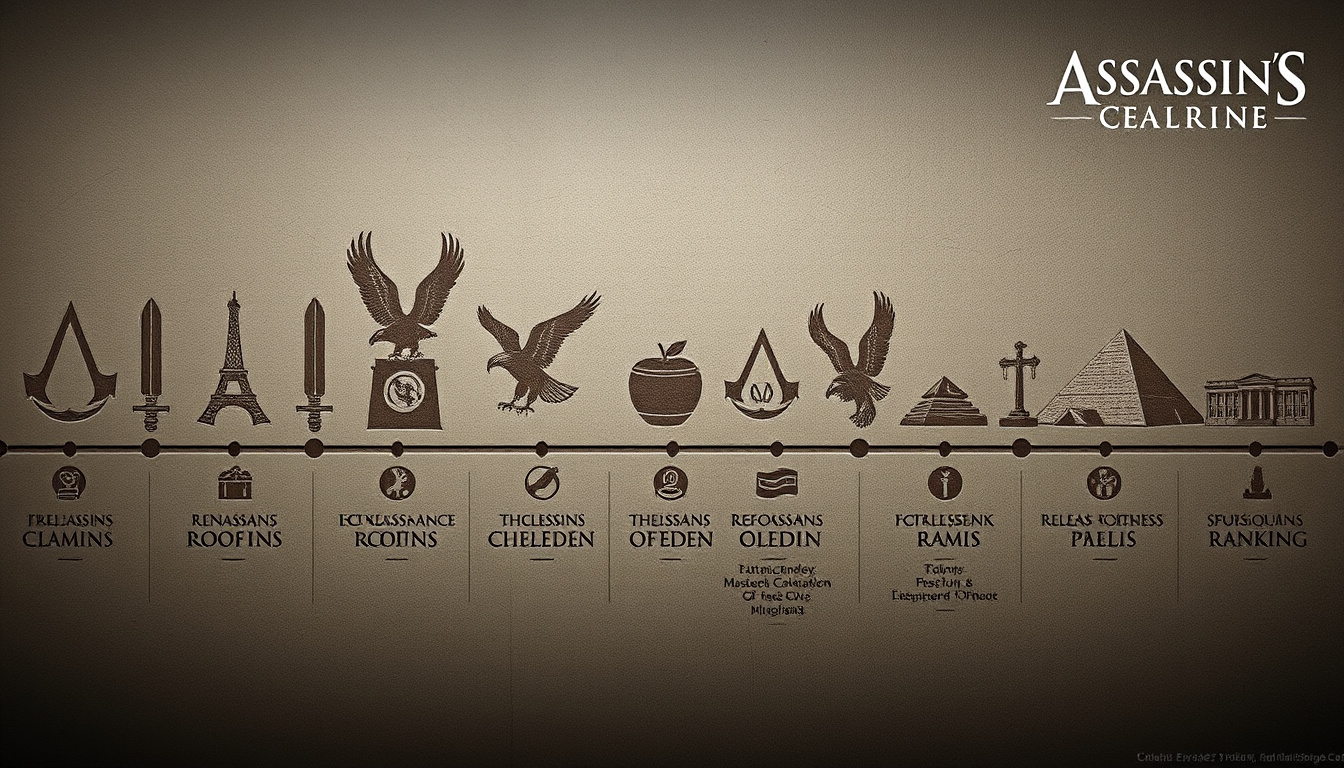
The Assassin’s Creed franchise stands as one of gaming’s most expansive narratives series, spanning fourteen mainline titles and over two decades of storytelling across historical eras. From the Crusades to feudal Japan, players have traversed time through the Animus technology, following the eternal conflict between Assassins and Templars. This guide presents every mainline game organized by release chronology, narrative timeline, and recommended play sequence.
Whether players seek to experience the franchise’s evolution chronologically, follow the iconic Ezio trilogy in sequence, or simply understand which titles rank highest according to community consensus, this comprehensive resource addresses the fundamental question of how to approach Ubisoft’s flagship series. The information reflects verified sources including official Ubisoft announcements, community wikis, and gaming publications that track the franchise’s development.
Assassin’s Creed Games in Order to Play
Choosing where to begin the Assassin’s Creed journey depends largely on whether players prioritize narrative continuity or gameplay evolution. The series underwent significant mechanical transformation beginning with Assassin’s Creed Origins in 2017, shifting from stealth-focused action toward more expansive RPG systems. This distinction matters considerably for newcomers deciding their entry point.
Quick Overview: All Four Ordering Methods
| Ordering Method | Starting Point | Best For |
|---|---|---|
| Release Order | Assassin’s Creed (2007) | Series evolution appreciation |
| Chronological Order | Assassin’s Creed Odyssey (431 BC) | Timeline immersion |
| Recommended Play Order | Origins → Odyssey → Valhalla → Mirage → Shadows | Modern gameplay experience |
| Quality Ranking | Assassin’s Creed II (2009) | Best narrative first |
Key Insights for New Players
- The franchise contains 14 mainline titles plus over 20 spin-offs released between 2007 and 2025
- Games before Origins (2007-2015) feature interconnected modern-day framing and Desmond’s story arc
- Post-Origins titles (2017-present) operate as semi-independent RPG experiences with minimal narrative overlap
- The Ezio Trilogy (II, Brotherhood, Revelations) represents the series’ narrative peak according to critics and fans
- Assassin’s Creed Shadows (2025) introduces feudal Japan as the upcoming setting
- Most titles remain playable across PC, PS4, PS5, and Xbox platforms via remastered versions or backward compatibility
- Spin-off titles including Chronicles trilogy and mobile releases are optional for the core experience
Core Game Snapshot
| Game | Year | Setting | Protagonist | Platforms |
|---|---|---|---|---|
| Assassin’s Creed II | 2009 | Renaissance Italy | Ezio Auditore | PC, PS3, PS4, Xbox 360, Xbox One, Switch |
| Assassin’s Creed IV: Black Flag | 2013 | Caribbean | Edward Kenway | PC, PS3, PS4, Xbox 360, Xbox One, Switch |
| Assassin’s Creed Origins | 2017 | Ptolemaic Egypt | Bayek | PC, PS4, Xbox One |
| Assassin’s Creed Odyssey | 2018 | Ancient Greece | Alexios/Kassandra | PC, PS4, Xbox One |
| Assassin’s Creed Valhalla | 2020 | Viking Britain | Eivor | PC, PS4, PS5, Xbox One, Xbox Series X/S |
| Assassin’s Creed Mirage | 2023 | Baghdad (861 AD) | Basim | PC, PS4, PS5, Xbox One, Xbox Series X/S, iOS |
| Assassin’s Creed Shadows | 2025 | Feudal Japan | Yasuke/Naoe | PC, PS5, Xbox Series X/S, macOS, Switch 2 |
Modern titles from Origins onward support PC via Ubisoft Connect, Epic Games Store, and Steam. Older games received remastered releases for PS4, PS5, Xbox One, and Xbox Series X/S. Assassin’s Creed Shadows launches day-one on PS5 and PC, with Nintendo Switch 2 support following console launch.
Assassin’s Creed Games in Chronological Order
The Assassin’s Creed narrative spans millennia of human history, with each mainline title placing players within a distinct historical period. Understanding the chronological sequence reveals how Ubisoft constructed its fictional history through actual world events, weaving the Assassins and Templars conflict through civilizations from ancient Greece to feudal Japan.
Story Timeline: Ancient Eras First
Beginning with the oldest historical settings allows players to experience the franchise’s narrative development from earliest foundations. The chronological approach emphasizes how the conflict between freedom and control has shaped human civilization across distinct eras and geographies.
- Assassin’s Creed Odyssey — 431-422 BC, Ancient Greece during the Peloponnesian War between Athens and Sparta
- Assassin’s Creed Origins — 49-44 BC, Ptolemaic Egypt at the height of Cleopatra’s reign and Caesar’s conquest
- Assassin’s Creed Mirage — 861 AD, Baghdad during the Islamic Golden Age under the Abbasid Caliphate
- Assassin’s Creed Valhalla — 872-878 AD, Viking Britain during the raids and settlement period
- Assassin’s Creed — 1191 AD, the Third Crusade in the Holy Land
- Assassin’s Creed II — 1476-1499 AD, Renaissance Italy spanning Florence, Venice, and beyond
- Assassin’s Creed Brotherhood — 1499-1507 AD, Rome under Borgia control
- Assassin’s Creed Revelations — 1511-1512 AD, Constantinople during Ottoman siege
- Assassin’s Creed Shadows — 1579-1581 AD, feudal Japan during the Sengoku period
- Assassin’s Creed IV: Black Flag — 1715-1722 AD, the Caribbean Golden Age of Piracy
- Assassin’s Creed Rogue — 1752-1776 AD, the Seven Years’ War and early American Revolution
- Assassin’s Creed III — 1754-1783 AD, the American Revolution from French and Indian War to independence
- Assassin’s Creed Unity — 1789-1794 AD, the French Revolution in Paris
- Assassin’s Creed Syndicate — 1868 AD, Victorian London during industrial expansion
Playing chronologically from Odyssey through Syndicate offers a unique perspective on how the Assassin-Templar conflict evolved alongside actual historical developments. However, pre-Origins titles feature interconnected narrative threads that may lose coherence when experienced out of release sequence.
Assassin’s Creed Games in Release Order by Year
The release chronology demonstrates how Ubisoft Montreal and partner studios refined the franchise’s core mechanics over nearly two decades. Each successive title introduced new gameplay systems, expanded the historical sandbox, and evolved the modern-day narrative framing established in the original 2007 release.
The Classic Era (2007-2012)
The initial phase established fundamental stealth, parkour, and counter-based combat systems that defined the franchise identity. These games maintained consistent gameplay across Desmond’s journey through Altair and Ezio’s formative years, with limited open-world exploration within designated cities.
| Release Year | Game | Developer | Setting |
|---|---|---|---|
| 2007 | Assassin’s Creed | Ubisoft Montreal | Third Crusade Holy Land |
| 2009 | Assassin’s Creed II | Ubisoft Montreal | Renaissance Italy |
| 2010 | Assassin’s Creed: Brotherhood | Ubisoft Montreal | Rome |
| 2011 | Assassin’s Creed: Revelations | Ubisoft Montreal | Constantinople |
| 2012 | Assassin’s Creed III | Ubisoft Montreal | American Revolution |
The Sea Change Era (2013-2016)
Black Flag revolutionized the formula by emphasizing naval exploration and open-sea navigation, while maintaining core Assassin’s elements. Unity attempted ambitious co-operative multiplayer and Parisian architecture, though launch issues damaged reception. Syndicate returned to single-player with dual-protagonist twins and Victorian London’s industrial backdrop.
| Release Year | Game | Developer | Setting |
|---|---|---|---|
| 2013 | Assassin’s Creed IV: Black Flag | Ubisoft Montreal | Caribbean Pirates |
| 2014 | Assassin’s Creed Unity | Ubisoft Montreal | French Revolution Paris |
| 2014 | Assassin’s Creed Rogue | Ubisoft Sofia | Seven Years’ War |
| 2015 | Assassin’s Creed Syndicate | Ubisoft Quebec | Victorian London |
The RPG Evolution Era (2017-Present)
Origins marked a fundamental shift toward RPG mechanics including level-gated progression, loot systems, and extensive side content. This transformation divided longtime fans but expanded the audience considerably. Subsequent titles refined these systems while gradually reintroducing stealth-focused gameplay in Mirage and the upcoming Shadows release.
| Release Year | Game | Developer | Setting |
|---|---|---|---|
| 2017 | Assassin’s Creed Origins | Ubisoft Montreal | Ptolemaic Egypt |
| 2018 | Assassin’s Creed Odyssey | Ubisoft Quebec | Ancient Greece |
| 2020 | Assassin’s Creed Valhalla | Ubisoft Montreal | Viking Britain |
| 2023 | Assassin’s Creed Mirage | Ubisoft Bordeaux | Baghdad, 861 AD |
| 2025 | Assassin’s Creed Shadows | Ubisoft Quebec | Feudal Japan |
Assassin’s Creed Games Ranked Best to Worst
Community and critical consensus establishes clear favorites within the franchise, with the Ezio trilogy consistently occupying top positions for narrative depth and character development. However, rankings remain inherently subjective, and individual preferences for gameplay style significantly influence personal tier placements.
Top Tier: Essential Experiences
These titles represent the franchise at its finest, combining compelling narratives with refined gameplay systems and memorable historical settings. Each earned widespread acclaim and continues to define Assassin’s Creed excellence for longtime fans.
- Assassin’s Creed II — The definitive Assassin’s Creed experience, introducing Ezio Auditore’s journey from noble youth to master assassin. Florence and Venice settings remain iconic, while narrative pacing and gameplay variety established standards for sequels.
- Assassin’s Creed Brotherhood — Seamless sequel expanding Rome as a fully explorable city. The recruit system and multiplayer components added new dimensions, though the latter has since aged considerably.
- Assassin’s Creed IV: Black Flag — Naval combat reached its franchise peak with open Caribbean exploration. Though less Assassin-focused than predecessors, the pirate fantasy resonated broadly with players and critics.
- Assassin’s Creed Origins — The RPG transformation succeeded in creating a deeper progression system. Ptolemaic Egypt’s scale and beauty demonstrated Ubisoft’s environmental design capabilities.
- Assassin’s Creed Revelations — Ezio’s conclusive chapter delivered emotional closure while introducing Constantinople’s Ottoman architecture. The hookblade added verticality, though content felt abbreviated compared to Brotherhood.
Middle Tier: Solid Entries with Caveats
These games offer worthwhile experiences despite notable weaknesses or narrower appeal. Players with specific interests in particular settings or gameplay styles may find these titles more appealing than their rankings suggest.
- Assassin’s Creed Odyssey — Epic Ancient Greece setting with meaningful player choices and RPG depth. Extensive content caused fatigue, and loot systems frustrated players seeking tighter narrative focus.
- Assassin’s Creed Mirage — A return to stealth fundamentals following Valhalla’s bloated RPG systems. Compact Baghdad offered focused design, though shorter campaign left many wanting more.
- Assassin’s Creed Syndicate — Twin protagonists and Victorian London provided fresh mechanical and aesthetic territory. Forgettable story and weaker antagonists limited lasting impact.
- Assassin’s Creed — Groundbreaking 2007 foundation established franchise identity. Repetitive mission structure and limited gameplay variety date poorly compared to later refinements.
- Assassin’s Creed Rogue — Playing as a Templar offered refreshing perspective on the conflict. Linear structure and recycled Black Flag mechanics limited its distinctiveness.
These rankings reflect aggregated critical and community sentiment as of 2024. Assassin’s Creed Shadows remains unreleased and therefore positioned based on announced features rather than actual gameplay evaluation. Individual experiences vary considerably based on platform, personal preferences, and prior franchise familiarity.
Lower Tier: Significant Issues
- Assassin’s Creed III — Ambitious frontier setting struggled with bland protagonist Connor and technical problems. Naval sequences hinted at Black Flag’s potential, but overall execution disappointed.
- Assassin’s Creed Valhalla — Viking Britain offered scale and atmosphere, but extensive bloat and repetitive fetch quests frustrated completionists. Narrative pacing suffered from mandatory padding.
- Assassin’s Creed Unity — Paris architecture and co-operative gameplay demonstrated potential, but catastrophic launch bugs severely damaged reception. Despite patches, reputation lingered.
- Assassin’s Creed Shadows — Unreleased as of data cutoff. Feudal Japan setting generates considerable anticipation, with dual-protagonist system and stealth focus promising a strong entry.
Assassin’s Creed Ezio Games in Order
The Ezio Auditore trilogy represents Assassin’s Creed’s narrative apex, following one of gaming’s most complete protagonist arcs from arrogant youth through tragic loss to wise mentor. Ubisoft recognized this significance by remastering all three titles for modern platforms and offering them as the “Ezio Collection” bundle. The trilogy’s enduring popularity stems from its sophisticated storytelling and the emotional depth of Ezio’s four-decade journey across Renaissance Italy and beyond.
The Complete Ezio Sequence
Beginning with Assassin’s Creed II in 1476 Florence, Ezio’s story spans over four decades and three distinct historical settings. The interconnected narrative rewards sequential play, with character development and recurring antagonists building across each installment.
- Assassin’s Creed II — Ezio’s introduction covers his upbringing in Florence, the betrayal of his family, his training in Venice, and his quest for revenge against the Pazzi conspirators. The 2009 release established templates for narrative-driven Assassin’s Creed design.
- Assassin’s Creed Brotherhood — Set immediately after II’s conclusion, Ezio becomes the Master Assassin of Rome, building his order while confronting Rodrigo Borgia’s successors. First major sequel expanded scope significantly.
- Assassin’s Creed Revelations — Ezio’s final chapter finds him in Constantinople, older and seeking answers about Altair’s legacy. The narrative bridges connections between Ezio and the series’ original protagonist.
All three titles are available on PC, PS3, PS4, Xbox 360, Xbox One, and Nintendo Switch through remastered releases. The Ezio Collection packages them together for players seeking the complete experience on current-generation hardware. Playing these games consecutively, ideally after the original Assassin’s Creed, provides maximum narrative context and character appreciation.
Timeline: Series Evolution by Release and Story
Understanding both release chronology and narrative timeline helps players make informed decisions about their approach to the franchise. The following timeline highlights key franchise milestones alongside story periods.
- 2007 — Assassin’s Creed launches, establishing core mechanics and Desmond framing story. Source: Wikipedia
- 2009-2011 — Ezio Trilogy releases, defining franchise narrative standards. Source: Assassin’s Creed Fandom
- 2012-2015 — American Revolution, Caribbean piracy, and Victorian settings explored. Source: RadioTimes
- 2017 — Origins transforms gameplay into RPG systems. Source: TrueAchievements
- 2018-2020 — Odyssey and Valhalla refine RPG mechanics with Greece and Viking settings.
- 2023 — Mirage returns to stealth fundamentals with Basim’s Baghdad story.
- 2025 — Shadows introduces dual protagonists in feudal Japan. Source: Epic Games Store
What’s Clear and What Remains Uncertain
Transparency about what information is definitively established versus what remains subject to interpretation helps readers navigate the franchise’s complexity. The following distinction separates confirmed facts from areas where community consensus varies.
| Established Information | Uncertain or Subjective Areas |
|---|---|
| 14 mainline titles released 2007-2025 | Whether chronological or release order provides superior experience |
| Chronological story spans 431 BC to 1868 AD | Optimal starting point for new players |
| Ezio Trilogy considered narrative peak by critics | Personal rankings vary considerably by preference |
| Origins initiated RPG gameplay transformation | Whether this shift improved or diminished the franchise |
| Shadows launches 2025 with Japan setting | Actual quality until post-release evaluation |
| All titles available on PC and current consoles | Whether spin-offs contribute meaningfully to overall narrative |
Context: Why Multiple Orderings Exist
The Assassin’s Creed franchise’s unusual structure creates genuine ambiguity about optimal play sequences. Unlike linear series where release order aligns with story chronology, Assassin’s Creed jumps backward and forward through history with limited narrative continuity between most entries.
Pre-Origins titles (2007-2015) share interconnected modern-day framing through the Animus and Desmond Miles’s story. Players experiencing these out of order may encounter spoilers for earlier games or miss thematic callbacks. However, the modern-day narrative itself remains divisive, with many players engaging primarily with historical segments.
Post-Origins titles (2017-present) explicitly designed RPG experiences with minimal narrative dependency. Players can genuinely start with Origins, Odyssey, or Valhalla without confusion, though callbacks to earlier entries reward franchise veterans. This shift explains why Ubisoft markets these titles semi-independently rather than requiring sequential play. Those interested in how the series has evolved across different gaming eras may find it worthwhile to explore both the classic and modern approaches that have shaped the franchise’s identity over nearly two decades.
Sources and References
The following sources inform this guide’s factual claims and rankings. Official Ubisoft communications, community wikis, gaming publications, and retail databases contribute to the comprehensive picture of franchise history.
“The Assassin’s Creed franchise, developed primarily by Ubisoft, began in 2007 with 14 mainline titles released through 2025.”
— TrueAchievements, RadioTimes, Wikipedia aggregate
“Sources suggest release order for modern saga cohesion (post-Origins ‘RPG era’ builds sequentially: Origins → Odyssey → Valhalla → Mirage → Shadows).”
— Epic Games Store, TrueAchievements
“The Ezio Trilogy—core Renaissance arc starring Ezio Auditore—is widely recommended as the series’ narrative peak.”
— Assassin’s Creed Fandom, Wikipedia
Summary
The Assassin’s Creed franchise offers players multiple valid approaches depending on their priorities. Those seeking narrative continuity should follow either release order or the Ezio Trilogy consecutively. Players interested in modern gameplay should start with Origins and progress forward. Timeline-focused adventurers can begin with Odyssey’s ancient Greece and work outward. Rankings consistently favor the Ezio trilogy and Black Flag for their respective eras, while acknowledging that personal preferences significantly influence individual experiences. With 14 mainline titles spanning 2007 to 2025 and settings from ancient Greece to feudal Japan, the franchise provides extensive content for both newcomers and returning players. For those exploring similar gaming guides, our coverage of World on Fire cast offers additional entertainment recommendations.
Frequently Asked Questions
How many Assassin’s Creed games are there in total?
As of 2025, the franchise includes 14 mainline titles released between 2007 and 2025, plus over 20 spin-off games across various platforms and formats including mobile releases, the 2.5D Chronicles trilogy, and standalone expansions.
What is the best Assassin’s Creed game to start with?
New players should consider starting with Assassin’s Creed II for classic gameplay and storytelling, Assassin’s Creed Origins for modern RPG systems, or Assassin’s Creed IV: Black Flag for accessible naval gameplay. Each serves as a valid entry point depending on personal preferences.
Which Assassin’s Creed games are available on PC?
All 14 mainline titles are playable on PC through various storefronts including Steam, Epic Games Store, and Ubisoft Connect. Origins, Odyssey, Valhalla, and Mirage support PC directly, with most older titles receiving PC remasters or re-releases.
What order should I play the Ezio trilogy?
Play the Ezio trilogy in release sequence: Assassin’s Creed II, followed by Brotherhood, then Revelations. This order preserves narrative development and character arc progression. All three are available as the “Ezio Collection” on modern platforms.
Is Assassin’s Creed Shadows worth waiting for?
Assassin’s Creed Shadows (2025) introduces feudal Japan with dual protagonists and emphasizes stealth-focused gameplay, representing a return toward series fundamentals. While unconfirmed until release, the setting and design direction generate considerable anticipation among franchise fans.
Can I play Assassin’s Creed games on PlayStation 5?
PlayStation 5 owners can access most mainline titles through backward compatibility with PS4 versions or dedicated PS5 releases. Mirage, Valhalla, and Shadows specifically offer optimized PS5 versions. The Ezio trilogy and Black Flag are playable through PS4 remasters.
What is the chronological order of all Assassin’s Creed games?
Chronological order begins with Odyssey (431 BC), followed by Origins (44 BC), Mirage (861 AD), Valhalla (872 AD), the original (1191 AD), the Ezio trilogy (1476-1512 AD), Shadows (1580 AD), Black Flag (1715 AD), Rogue (1752 AD), AC III (1754 AD), Unity (1789 AD), and Syndicate (1868 AD).
Are spin-off games essential to the main story?
Spin-off titles including Chronicles, Altaïr’s Chronicles, Bloodlines, Identity, and Freedom Cry DLC are optional for understanding the main narrative arc. Players seeking only core experiences can skip these without missing essential story elements.

Daniel Mercer is Business & Economy Correspondent at RegionalReport.co.uk, covering regional business news, local economy, employment, retail and property.