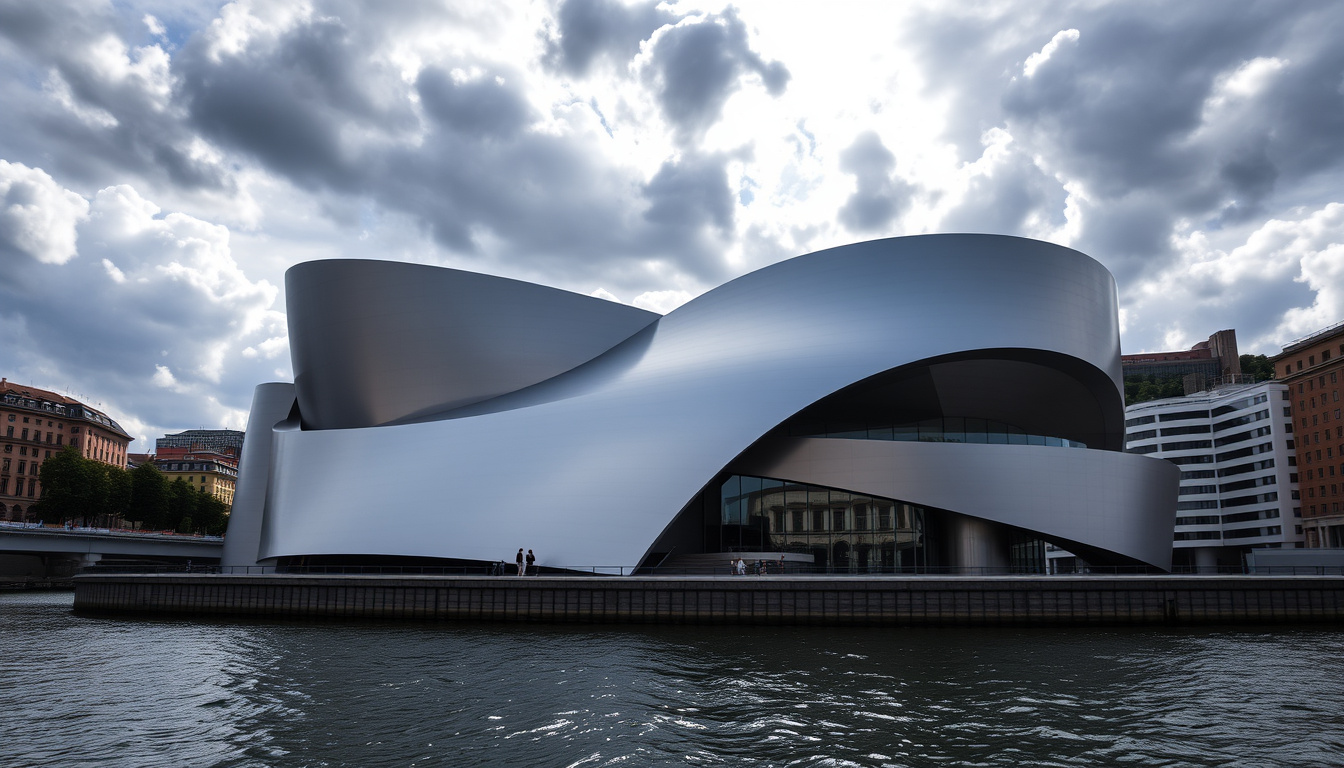
Frank Gehry, the Canadian-born American architect whose sculptural and unconventional buildings reshaped modern architecture, died on December 5, 2025, at his home in Santa Monica, California, at the age of 96. Over a career spanning more than six decades, he created some of the most recognizable structures in the world, from the shimmering titanium curves of the Guggenheim Museum Bilbao to the soaring stainless steel of the Walt Disney Concert Hall. Gehry’s work defied easy classification, blending deconstructivist forms with an intuitive, almost improvisational approach to design.
Born Frank Owen Goldberg in Toronto in 1929, Gehry moved to Los Angeles as a teenager and eventually built his practice around a philosophy that treated buildings not as static boxes but as dynamic compositions of volume, surface, and material. His willingness to experiment with chain-link fencing, corrugated metal, and plywood—alongside more glamorous titanium and glass—set him apart from his peers and made him one of the most influential architects of his time.
Gehry’s death marks the end of an era, but his buildings continue to draw millions of visitors each year, and his impact on urban revitalization, museum culture, and architectural expression remains profound.
What Are Frank Gehry’s Most Famous Buildings?
February 28, 1929, Toronto, Canada
2025 (age 95–96)
Deconstructivist architecture, Guggenheim Museum Bilbao, Walt Disney Concert Hall
Sculptural, unconventional forms, titanium, steel, glass
- Frank Gehry is regarded as one of the most innovative architects of the 20th and 21st centuries.
- His Guggenheim Museum Bilbao (1997) revolutionized museum architecture and sparked the “Bilbao effect.”
- Gehry’s work resists neat categorization; he blends deconstructivism with postmodern and expressive sculptural forms.
- He died in 2025, leaving a legacy of iconic buildings worldwide and inspiring a new generation of architects.
- His approach to materials—from chain-link fencing to titanium—challenged conventions about what architecture could look like.
- Gehry won the Pritzker Architecture Prize in 1989, cementing his status among the profession’s elite.
| Field | Detail |
|---|---|
| Full Name | Frank Owen Gehry |
| Birthplace | Toronto, Ontario, Canada |
| Nationality | Canadian-American |
| Education | University of Southern California, Harvard University (briefly) |
| Firm | Gehry Partners, LLP |
| Major Awards | Pritzker Prize (1989), AIA Gold Medal (1999) |
| Most Cited Building | Guggenheim Museum Bilbao |
| Death | 2025 |
Gehry’s body of work includes dozens of major projects across the globe. The Guggenheim Museum Bilbao, which opened in 1997, is widely considered his masterpiece. Its curving titanium-clad forms sit beside the Nervión River and helped transform Bilbao from an industrial city into a major cultural and tourist destination, according to Britannica. The building’s success produced the term “Bilbao effect,” describing how a prominent cultural building can stimulate tourism, investment, and urban renewal.
The Walt Disney Concert Hall in Los Angeles, opened in 2003, became one of the city’s defining landmarks with its sweeping stainless-steel exterior. BBC News notes that it helped anchor the redevelopment of downtown Los Angeles. Gehry’s renovation of his own house in Santa Monica, completed in the late 1970s, was an early statement of his mature style, wrapping a modest 1920s bungalow with chain-link fencing, corrugated metal, plywood, and glass.
Other notable works include the Fondation Louis Vuitton in Paris, characterized by large glass “sails”; the Dancing House in Prague, designed with Vlado Milunić; the Jay Pritzker Pavilion in Chicago; the Gehry Tower in Hanover, Germany; the Biomuseo in Panama City; the New World Center in Miami Beach; the Facebook headquarters in Menlo Park; and 8 Spruce Street in New York. A full list of his well-known buildings is available in an Architectural Digest slideshow that features 34 of his designs.
What Is Frank Gehry’s Architectural Style?
Gehry’s work is commonly associated with deconstructivism, although he resisted being placed in a single stylistic category, according to Finestre sull’Arte and BBC. His buildings are recognized for fragmented geometries, curving and twisting surfaces, and sculptural compositions that suggest movement. He deliberately contrasts rough and refined materials, using stainless steel, titanium, glass, plywood, corrugated metal, and chain-link fencing.
Deconstructivism and Beyond
Rather than treating buildings as static rectangular containers, Gehry approached them as compositions of volumes, surfaces, and materials. His designs can appear to crumple, billow, ripple, or unfold while still accommodating complex structural and functional requirements, as noted by The Art Story and the German Design Council. His buildings attracted both admiration and criticism: supporters viewed them as dynamic works of art that revitalized cities; critics questioned their cost, construction complexity, or suitability for everyday use.
Gehry’s design process often began with loose, gestural freehand sketches representing movement and volume. He then built physical models from paper, cardboard, and wood, manipulating forms iteratively before using digital modeling to translate irregular shapes into buildable structures. Engineering collaboration was essential to resolve complex surfaces and loads.
Materials and Innovation
Gehry’s early use of everyday, unfinished materials like chain-link fencing and corrugated metal—most famously in his own Santa Monica house—prefigured his later use of titanium and glass. He also produced furniture, including the Easy Edges series of corrugated-cardboard chairs and tables from the 1970s, reflecting his interest in elevating ordinary materials.
Frank Gehry Net Worth and Personal Life
Net Worth Estimates
Gehry’s exact net worth has never been publicly confirmed by his firm or family. Third-party estimates vary widely, and no reliable financial disclosure exists. His wealth derived from architectural commissions, consulting, and royalties from his furniture and design objects. Given his decades of high-profile projects, many estimates place his net worth in the tens of millions of dollars, but these figures remain speculative.
His House in Santa Monica
Gehry’s personal residence in Santa Monica, California, is one of his most famous early works. Completed in 1978, it involved renovating an existing 1920s bungalow by wrapping it with chain-link fencing, plywood, and corrugated metal, creating angular additions that made the familiar structure appear unstable and newly assembled. BBC News describes it as a crucial early statement of his mature approach. The house remains a private residence.
Unlike some public figures, Gehry did not publish detailed financial records. Media reports often cite net worth figures without verified sources. Readers should treat third-party net worth estimates as rough approximations rather than confirmed facts.
Frank Gehry Book: What Has He Written or Inspired?
Monographs and Exhibition Catalogs
Gehry’s work has been documented in numerous books. Notable titles include Frank Gehry: The Complete Works by Francesco Dal Co and Kurt W. Forster; Frank Gehry, Architect by Mildred Friedman; and Frank Gehry: Architecture + Process by Michael Sorkin. Many of these volumes explore his drawings and design process, offering insight into how his sketches evolved into built form.
Gehry Draws and Other Publications
Books focusing specifically on his drawing practice, such as Gehry Draws, treat his sketches as independent works of art. His drawings often begin as abstract diagrams and gestural marks before being refined through digital modeling. The German Design Council notes that the contrast between spontaneous sketches and highly technical construction models is central to his practice.
Multiple sources, including Gagosian and Britannica, confirm his death in 2025, but none provide a verified net worth. Any specific number online should be cross-checked with primary sources and treated as unconfirmed.
Timeline of Frank Gehry’s Life and Career
- 1929 – Born in Toronto, Canada.
- 1947 – Moved to Los Angeles with his family.
- 1954 – Graduated from the University of Southern California School of Architecture.
- 1962 – Established Frank Gehry and Associates (later Gehry Partners).
- 1989 – Awarded the Pritzker Architecture Prize.
- 1997 – Guggenheim Museum Bilbao opens, becoming his most iconic work.
- 2003 – Walt Disney Concert Hall in Los Angeles opens.
- 2014 – Fondation Louis Vuitton in Paris opens.
- 2025 – Frank Gehry dies at age 95.
Sources for the timeline include Wikipedia, Britannica, and Gagosian.
What Is Confirmed and What Remains Uncertain?
| Established Information | Information That Remains Unclear |
|---|---|
| Frank Gehry was born in 1929 and died in 2025 (confirmed by Gagosian and Britannica). | Exact net worth is not publicly confirmed; third-party estimates vary widely. |
| He designed the Guggenheim Museum Bilbao, Walt Disney Concert Hall, and dozens of other buildings. | Details of his last projects and posthumous influence will continue to unfold. |
| His style is characterized by sculptural forms and unconventional materials. | Wikipedia had not yet updated his death date as of initial reports; users should rely on official gallery and encyclopedia sources. |
What Was Frank Gehry’s Impact on Architecture?
Frank Gehry’s impact extends far beyond individual buildings. The “Bilbao effect” demonstrated that a striking cultural structure could revitalize an entire city’s economy and tourism, influencing municipalities worldwide to invest in landmark museums and concert halls designed by celebrity architects. Gehry’s early work with chain-link fencing and corrugated metal in his Santa Monica house prefigured his later use of titanium and glass, showing that inexpensive materials could be used deliberately and aesthetically.
His design approach—starting with hand-drawn sketches, followed by physical models and digital coordination—retained a sense of improvisation and intuition even in large-scale projects. This method has been studied and emulated by a generation of younger architects. Gehry also contributed to the field of furniture design with his Easy Edges series, made from corrugated cardboard.
The success of the Guggenheim Bilbao also intensified debate over “starchitecture,” where cities use celebrity architects to market themselves. Yet Gehry’s buildings remain among the most visited cultural destinations in the world.
For a deeper look at another creative titan who transformed his industry, read Christian Dior – His Life, Death, and Enduring Legacy.
What Do Critics and Sources Say?
“Architecture should speak of its time and place, but yearn for timelessness.”
Frank Gehry
“The Guggenheim Museum Bilbao is a masterpiece of 20th-century architecture.”
Britannica
Further reading on Gehry’s life and work can be found through the Guggenheim Bilbao official site, Gagosian, and Architectural Digest. The Connecticut Public article was one of the first to report his death.
What Is Frank Gehry’s Legacy?
Frank Gehry left behind a body of work that permanently altered the course of architecture. His buildings continue to attract millions of visitors, and his fearless approach to materials and form has inspired architects, artists, and designers worldwide. While his exact net worth and some details of his later years remain unclear, his monumental contributions to the built environment are unquestioned. His legacy is not just a collection of buildings but a new way of imagining what architecture can be. For another story of an innovator who reshaped his domain, see Alexander Graham Bell – Biography, Inventions and Legacy.
Frequently Asked Questions About Frank Gehry
Is Frank Gehry still alive?
According to official sources (Gagosian and Britannica), Frank Gehry died in 2025 at age 95. Some web pages may not have been updated yet.
What materials does Frank Gehry use?
He is known for using titanium, stainless steel, glass, chain-link fencing, and corrugated metal, often in sculptural, flowing forms.
How many buildings has Frank Gehry designed?
He has designed hundreds of projects worldwide; Architectural Digest lists 34 of his best-known buildings.
What is Frank Gehry’s most famous building?
The Guggenheim Museum Bilbao (1997) is widely considered his masterpiece.
Did Frank Gehry design his own house?
Yes, his personal home in Santa Monica, California (1978) is an early example of his deconstructivist style, using chain-link and plywood.
What books are recommended about Frank Gehry?
Popular titles include “Frank Gehry: The City and Music” and “Gehry Draws,” which explore his works and creative process.
What architectural style is Frank Gehry known for?
He is associated with deconstructivism, though he resisted labels. His style is sculptural, with fragmented forms and unusual materials.
Did Frank Gehry win the Pritzker Prize?
Yes, he was awarded the Pritzker Architecture Prize in 1989.
Where was Frank Gehry born?
He was born in Toronto, Ontario, Canada, on February 28, 1929.

Margaret Ellison is Editor-in-Chief at RegionalReport.co.uk, overseeing editorial policy, corrections, standards and publication decisions. She writes occasional leader columns and major regional news stories.