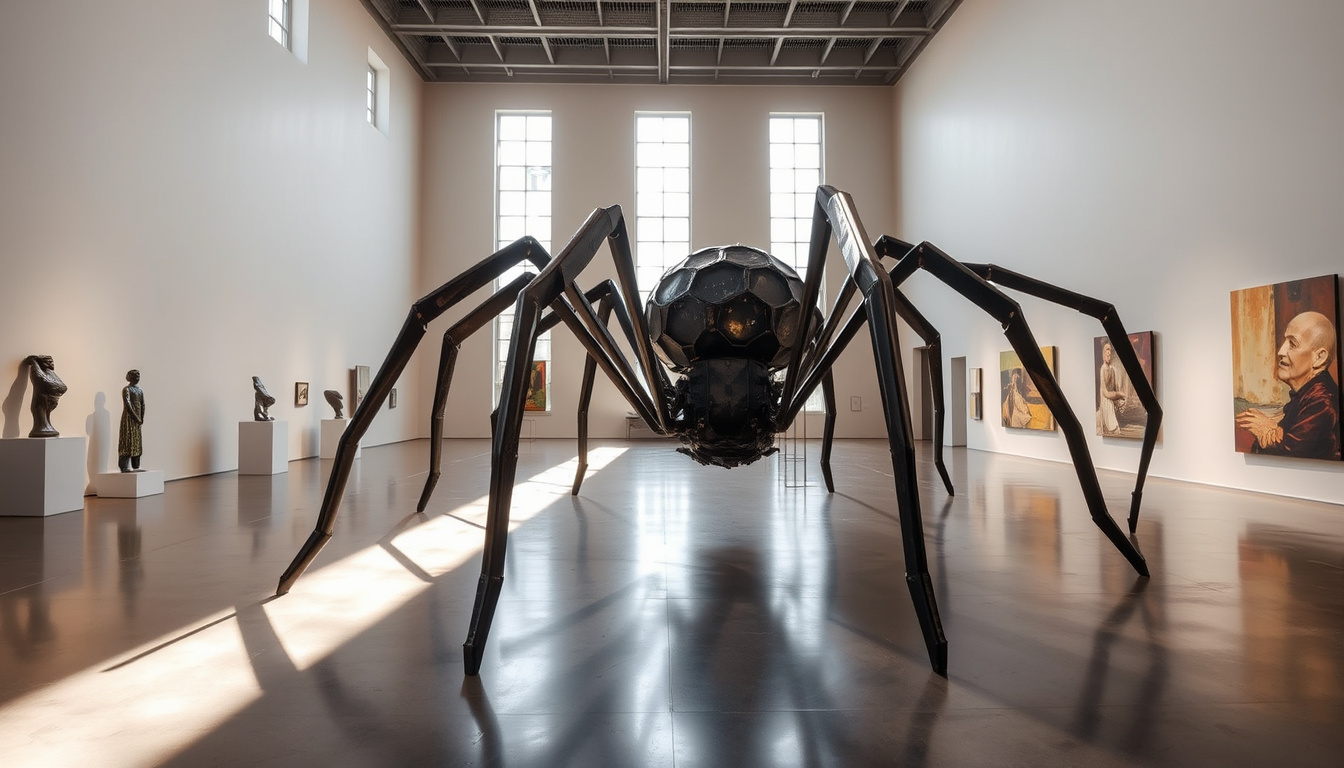
Louise Bourgeois turned personal anguish into monumental art. Best known for her towering spider sculptures and the claustrophobic Cells series, the French-American artist spent decades exploring motherhood, memory, and the body. Her work continues to dominate museum collections and auction records, yet the stories behind the steel and latex remain less understood.
Born in Paris in 1911, Bourgeois spent nearly a century shaping a body of work that defied easy classification. She absorbed surrealism and abstract expressionism but never belonged to any movement. Instead, she built a private visual language from childhood trauma, family history, and a relentless drive to externalize inner turmoil.
Her late-career rise, capped by the unveiling of Maman at Tate Modern in 2000, cemented her as one of the most influential sculptors of the 20th century. A new biography published in 2026, Knife-Woman, examines the therapeutic revisiting of childhood wounds that fueled her creative output.
What is the Meaning Behind Louise Bourgeois’ Iconic Spider Sculptures?
The question that draws most visitors to Bourgeois’s work is also the one with the most direct answer. The spiders are not random monsters. They are deliberate, layered symbols of maternity.
Born
1911, Paris, France
Died
2010, New York, USA
Known For
Large-scale sculpture, installation art, spider series (‘Maman’)
Key Themes
Family, memory, the unconscious, femininity, and trauma
- Spider as mother: Bourgeois used spider imagery to symbolize her mother, whom she described as patient, protective, and a weaver. This interpretation is consistent across multiple curated museum texts.
- Cells as psychological space: Her ‘Cells’ series represents physical and psychological spaces, often referencing childhood trauma and memory, according to Tate and MoMA curatorial analyses.
- Drawings prefigure sculpture: Despite working in sculpture, Bourgeois was also a prolific drawer; her drawings often prefigure her three-dimensional works, per MoMA collection notes.
- A reluctant feminist icon: Bourgeois is often cited as a key figure in feminist art, though she rejected the label, preferring to be seen as a personal storyteller, as recorded in multiple interviews and biographies.
| Label | Value |
|---|---|
| Full Name | Louise Joséphine Bourgeois |
| Birth | December 25, 1911, Paris, France |
| Death | May 31, 2010, New York City, USA |
| Nationality | French-American |
| Education | Sorbonne, École du Louvre, École des Beaux-Arts, Académie Julian |
| Movement | Modern art, feminist art (affiliated), surrealism (influenced) |
| Most Famous Work | “Maman” (1999), a 30-foot tall spider sculpture |
| Spouse | Robert Goldwater (art historian), married 1938–1973 |
Bourgeois viewed her spiders as ambivalent representations of maternity, acting as both predators and protectors, according to sources including The Art Newspaper and Art21. They symbolize the protective nature of the mother while also acknowledging the potential danger of the maternal figure. The most famous example, Maman (1999), is a 30-foot steel and marble sculpture first installed at the Turbine Hall of the Tate Modern in 2000.
The name is deliberate: “Maman” is French for “Mother,” directly honoring her own mother, Joséphine, who was a weaver and seamstress. The spiders are constructed from steel, marble, rubber, and fabric, reflecting her later-career experimentation with diverse materials.
Who Was Louise Bourgeois? A Biography of the French-American Artist
Louise Joséphine Bourgeois was born on December 25, 1911, in Paris, to Louis Bourgeois and Joséphine Fauriaux. She grew up in a family tapestry-restoration workshop, an environment that steeped her in textiles, repair, and the physical handling of materials.
Early Education and a Pivot to Art
She initially studied mathematics at the Sorbonne before switching to art studies at the École du Louvre and Académie Julian. In 1938, she married American art historian Robert Goldwater and moved to New York City, where she raised three sons and began her artistic career in earnest.
Career Trajectory and Shifting Materials
Bourgeois started with wooden totemic sculptures, the Personnages (1947–1953), which represented lost friends and family. She later shifted to rubber, latex, marble, and metal as the ambition of her work expanded. After her early wooden works, she moved toward pliable latex and rubber in the 1960s, creating softer, more organic forms that explore sexuality, the body, and domesticity, using materials that evoke skin and flesh as a way to externalize and control her emotions.
Much of Bourgeois’s work draws on childhood trauma, particularly her father’s affair with her tutor. Art became a tool for exorcism and understanding, a theme explored in depth in the 2026 biography Knife-Woman.
She received her first major recognition after a 1982 retrospective at the Museum of Modern Art (MoMA) and represented the United States at the 1993 Venice Biennale. Although Bourgeois denied being a “feminist” with a political agenda, her work is foundational to feminist art due to its focus on birth, pain, motherhood, and the female body.
What Materials Did Louise Bourgeois Use in Her Soft Sculptures and Installations?
The material range in Bourgeois’s oeuvre is one of its defining features. She worked in wood, steel, marble, rubber, latex, glass, and fabric, often in the same piece. The Cells series, first shown in 1991, uses enclosed, room-like structures to create spaces of both imprisonment and safety, representing her complex relationship with family life, which she described as a space “enchanted and accursed” but impossible to avoid.
Key Examples from the Cells Series
Precious Liquids (1992) features a decommissioned water tower with a bed inside, covered in spilled liquid and surrounded by glass containers, alluding to human body fluids. The Quartered One (1964–65) is a suspended bronze sculpture resembling a skinned carcass with a hollow interior, blurring the inside and outside.
Soft Sculptures
Soft sculpture refers to Bourgeois’s works made from pliable materials like latex, fabric, and thread. These works often explore the body in architectural space. Her soft sculptures are housed in major collections and are a key point of interest for those looking to understand her technical evolution.
Bourgeois was a prolific drawer whose graphic output often prefigured her three-dimensional works. MoMA’s collection notes highlight drawings as integral to her creative process. They offer a more intimate entry point for viewers unfamiliar with her large-scale installations.
How Do You Pronounce Louise Bourgeois and Other Basic Facts?
The correct spelling is L-O-U-I-S-E B-O-U-R-G-E-O-I-S. A common misspelling is “Bourgois,” which omits the necessary “e” and “i.” Pronunciation varies slightly between French and English.
- Louise: “Loo-ee” (French)
- Bourgeois: “boo-zhwah” (French); in English, often “boo-gehwis” or “boo-zhwah”
- Maman: “ma-mahn”
Where Can You See Louise Bourgeois Artwork: Museums and Major Exhibitions
Bourgeois’s work is held by virtually every major museum of modern and contemporary art. Her first Spider was installed at the Brooklyn Museum in 1994. Maman became the inaugural installation for the Tate Modern’s Turbine Hall in 2000 and remains on view at the museum. The Centre Pompidou in Paris (Beaubourg) holds a major collection and has hosted significant retrospectives.
Other institutions with deep holdings include the Museum of Modern Art (MoMA) in New York, the National Museum of Women in the Arts in Washington, D.C., and Hauser & Wirth gallery, which represents her estate. The new biography Knife-Woman (2026) covers her “rich life” in detail.
Louise Bourgeois: Key Life & Career Timeline
- 1911: Born in Paris to tapestry restorers.
- 1938: Marries Robert Goldwater and moves to New York City.
- 1940s: Begins exhibiting paintings and prints; opens a print shop.
- 1949: First solo sculpture exhibition at Peridot Gallery, New York.
- 1970s: Shift to large-scale installations; begins teaching and gains recognition from feminist art critics.
- 1982: First retrospective at the Museum of Modern Art (MoMA), New York.
- 1990s: Creates the ‘Cells’ series; international acclaim accelerates.
- 1999: Unveils Maman at Tate Modern’s opening.
- 2000s: Continued production and global exhibitions; receives the National Medal of Arts (2000).
- 2010: Dies in New York at age 98.
Clarifying Common Misconceptions and Uncertainties
| Established Information | Information That Remains Unclear |
|---|---|
| The spider Maman represents a mother. Bourgeois explicitly stated that the spider represents her mother, who was a weaver. | Whether Bourgeois was a purely feminist artist. While her work is championed by feminist scholars, she stated she did not work with a political agenda in mind, focusing instead on personal psychology. |
| Bourgeois worked in a vast range of materials including latex, wood, glass, marble, and fabric for soft sculptures, not only large steel sculptures. | Whether her work can be easily categorized as surrealist. While influenced by surrealist ideas of the unconscious, her methodical, autobiographical approach resists pure surrealist classification. |
Why Louise Bourgeois Matters: Context and Legacy
Bourgeois came of age during the height of Abstract Expressionism and Surrealism, yet she carved a unique path that anticipated installation art and participatory practices. Much of her work draws on childhood trauma, particularly her father’s affair with her tutor. Art became a tool for exorcism and understanding.
As a female artist who achieved major success late in life, Bourgeois paved the way for contemporary artists like Tracey Emin and Kiki Smith. Her auction records continue to rise, and she remains a central figure in discussions about the body, memory, and the domestic sphere in art. Readers interested in in-depth biographical profiles of other creative figures may also enjoy Ralph Fiennes – The Career of a Truly Versatile Actor and Brian May – Guitarist, Astrophysicist, and Animal Activist.
Key Sources and Quotations
“The spider is about my mother. She was a weaver.”
Louise Bourgeois, quoted in multiple museum texts
“Art is a guarantee of sanity.”
Louise Bourgeois, from interviews and biographies
Key sources for further reading include the Wikipedia entry for comprehensive biography and chronology, the Tate Museum page for curatorial essays and collection highlights, and the Hauser & Wirth biography for exhibition history. The MoMA collection records provide authoritative archival notes, while the Centre Pompidou holds major European retrospective references.
What to Explore Next in Bourgeois’s Work
For those looking to go deeper, checking for current or upcoming retrospectives at major museums, such as the Centre Pompidou and Tate Modern, is a practical step. Recently published scholarly monographs and exhibition catalogs continue to update her legacy. Digital archives, including those from Hauser & Wirth, frequently release new high-resolution images and correspondence from the artist’s estate.
Frequently Asked Questions
What is soft sculpture in Louise Bourgeois’ work?
Soft sculpture refers to Bourgeois’ works made from pliable materials like latex, fabric, and thread. ‘Femme Maison’ (1946–47) is an early example of this technique, exploring the body in architectural space.
What books have been written about Louise Bourgeois?
Notable books include ‘Louise Bourgeois: An Unfolding Portrait’ (MoMA), ‘Louise Bourgeois: The Complete Prints & Books’, and ‘Louise Bourgeois: It Has Been a Long Time’.
How did Louise Bourgeois die?
She died of a heart attack on May 31, 2010, at the Beth Israel Medical Center in New York City. She was 98.
Is Louise Bourgeois a feminist artist?
Her work is frequently interpreted through a feminist lens due to its focus on the female body, domesticity, and maternal relationships. However, Bourgeois herself often resisted this label.
What is the correct spelling of Louise Bourgeois?
The correct spelling is L-O-U-I-S-E B-O-U-R-G-E-O-I-S. A common misspelling is ‘Bourgois’ missing the ‘e’ and ‘i’.
What was the first major museum to recognize Bourgeois?
The Museum of Modern Art (MoMA) in New York gave her the first major retrospective in 1982.
Did Bourgeois only create large sculptures?
No. She worked in drawing, printmaking, and small-scale soft sculptures throughout her career, alongside her monumental installations.
Where did Bourgeois study before turning to art?
She initially studied mathematics at the Sorbonne in Paris before switching to art studies at the École du Louvre and Académie Julian.

Margaret Ellison is Editor-in-Chief at RegionalReport.co.uk, overseeing editorial policy, corrections, standards and publication decisions. She writes occasional leader columns and major regional news stories.