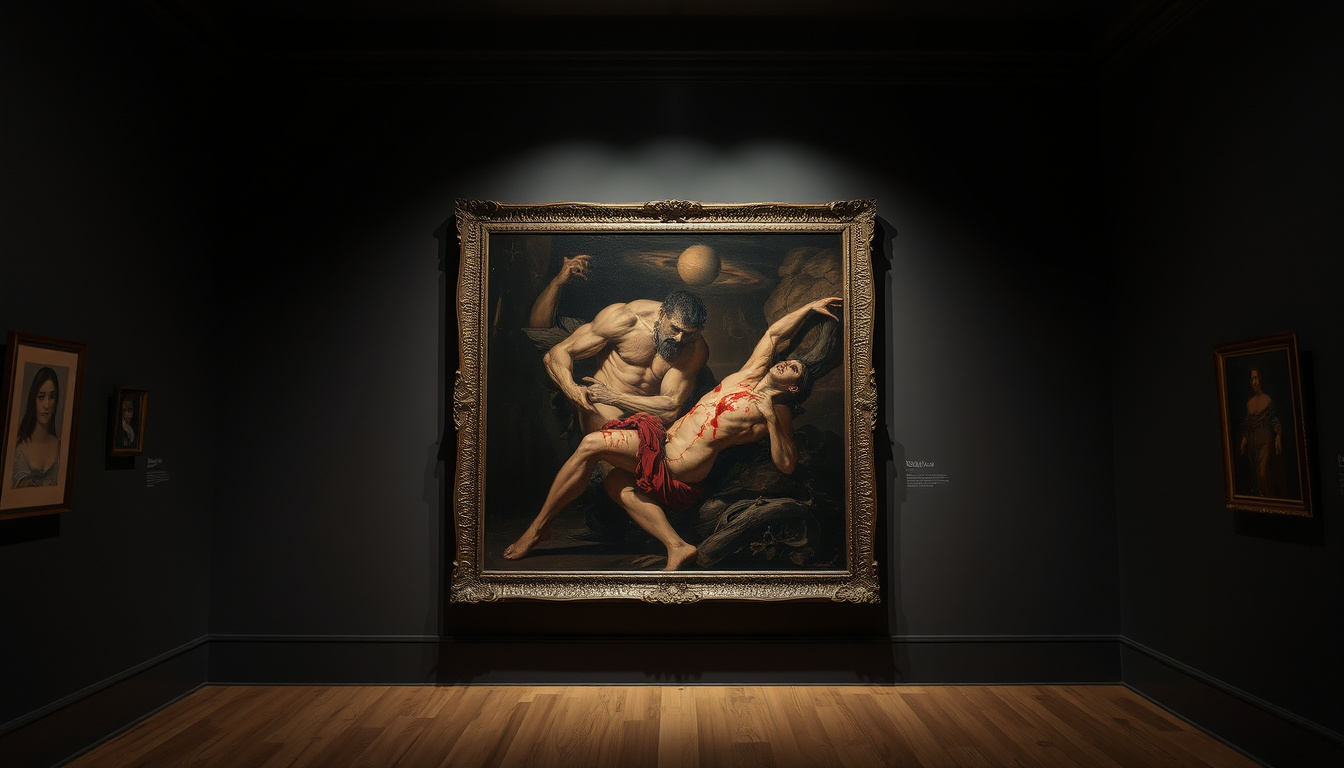
Francisco Goya’s Saturn Devouring His Son is one of the most unsettling images in Western art. Painted directly onto the plaster wall of the artist’s home between 1819 and 1823, it depicts a giant figure consuming a human body. The work resists easy explanation and has provoked debate for nearly two centuries.
The painting belongs to a group known as the Black Paintings, a series of 14 murals Goya created in isolation at his country house, Quinta del Sordo (Villa of the Deaf Man), on the outskirts of Madrid. These were private works, never intended for public exhibition. Today, the painting hangs in the Museo del Prado in Madrid, where it remains one of the most visited and discussed pieces in the collection.
What Is the Meaning of Saturn Devouring His Son?
The meaning of Saturn Devouring His Son operates on multiple levels. At its most direct, it illustrates a classical myth. But scholars have also read it as an allegory of time, political violence, old age, and personal anguish. No single interpretation is universally accepted, partly because Goya left no written explanation of the work.
Francisco Goya
c. 1819–1823
Oil mural transferred to canvas
Museo del Prado, Madrid (current)
- Saturn Devouring His Son is one of Goya’s 14 Black Paintings, painted directly on the walls of his home.
- The painting draws from the Greek myth of Cronus (Roman Saturn), who ate his children to prevent a prophecy.
- Goya painted the work in isolation during the later years of his life, reflecting personal despair and political turmoil.
- The painting is presumed to depict Saturn, but no original title exists; the identification is based on art historical interpretation.
- Saturn Devouring His Son is considered one of the most disturbing masterpieces in Western art history.
| Fact | Details |
|---|---|
| Full Title | Saturn Devouring His Son (also known as Saturn Devouring One of His Sons) |
| Artist Nationality | Spanish |
| Dimensions | 143.5 cm × 81.4 cm (56.5 in × 32.0 in) |
| Series | Black Paintings (Pinturas negras) |
| Current Location | Museo del Prado, Madrid, Spain |
| Subject Identification | Presumed; no definitive title by Goya exists |
| Transfer to Canvas | 1874–1876 by Salvador Martínez Cubells |
| Accession Number (Prado) | P000763 |
What Mythological Story Does Saturn Devouring His Son Show?
The painting draws from the Greco-Roman myth of Cronus, known to the Romans as Saturn. According to the story, a prophecy foretold that one of Cronus’s children would overthrow him. In an attempt to escape this fate, he swallowed each child at birth. The myth ultimately records that his wife, Rhea, hid the youngest child, Zeus, who later returned to dethrone his father.
The Greek Myth of Cronus (Saturn)
In Hesiod’s Theogony, Cronus is a Titan who rules during a golden age. The prophecy of overthrow comes from his parents, Gaia and Uranus. Cronus’s response — consuming his own offspring — establishes him as a figure of paranoia and brutal self-preservation. Goya seizes on this moment of consumption, but he removes any sense of heroism or dignity from the scene.
Goya’s Selection of the Saturn Myth
Goya did not choose a triumphant or redemptive version of the myth. He painted the instant of devouring itself, with the god shown as a wild, wide-eyed figure whose hands dig into flesh. This choice has led many to believe Goya was less interested in the classical narrative than in what the myth could express about human cruelty.
Comparison: Goya’s Saturn vs. Traditional Depictions
Earlier artists such as Peter Paul Rubens had painted the same subject, but their versions showed a composed, godlike Saturn performing a distanced act. Goya’s Saturn is bestial, dishevelled, and immersed in shadow. The contrast is stark and has been widely noted by art historians at Britannica as a radical departure from visual tradition.
In the traditional myth, Cronus succeeds in swallowing five of his children. The sixth, Zeus, is hidden by Rhea and later forces Cronus to regurgitate the others. Goya’s painting captures none of that eventual resolution. It shows only the act of consumption, frozen and unresolved.
Where Is the Original Saturn Devouring His Son Painting Located?
The painting now hangs in the Museo del Prado in Madrid, but it did not begin its life in a museum. It was painted on the plaster wall of the lower floor of Goya’s country house, Quinta del Sordo. Decades after Goya’s death, the murals were transferred to canvas so they could be preserved and moved.
From Villa de la Quinta del Sordo to the Prado Museum
Goya lived at Quinta del Sordo from around 1819 until 1823, when he fled Spain due to political repression. The house passed to his grandson. In 1874, the new owner allowed the murals to be removed from the walls. The transfer was carried out by Salvador Martínez Cubells, a professional restorer, between 1874 and 1876. By 1878, the Black Paintings were exhibited at the Paris World’s Fair, and in 1881, the Prado Museum acquired them.
Transfer to Canvas: Restoration and Preservation
The process of transferring oil mural to canvas was delicate and invasive. The plaster backing was removed, and the paint layer was adhered to canvas. Some damage occurred during the process, and the painting today shows the effects of age and its original mural format. The Prado has performed multiple conservation treatments on the work. Artnet News has documented the ongoing care the painting requires.
Why Did Goya Paint Saturn Devouring His Son?
Goya never publicly explained why he created the Black Paintings. The series was private, and the works were unknown to the public until decades after his death. Any explanation must be pieced together from biographical evidence and the historical context of Spain in the early 1820s.
Goya’s Later Years: Illness, Isolation, and Darkness
By 1819, Goya was in his seventies. He had survived a severe illness in 1793 that left him permanently deaf. Several of his children had died young, and his wife had also died. He purchased Quinta del Sordo partly as a retreat. The timing of the Black Paintings coincides with a period of profound personal solitude. Writing on the Quinta del Sordo period has noted how the house became a space for unfiltered expression.
The Black Paintings as a Series
The 14 Black Paintings include scenes of witches, satyrs, pilgrimage, and violence. They share a dark palette, loose brushwork, and a mood of dread. Because they were painted on walls, they are not conventional easel paintings. They are immersive, almost environmental. The series as a whole is often interpreted as Goya’s most personal statement, uncensored by patrons or public expectation. Scholars at Smarthistory describe them as works that blur the line between private imagination and public commentary.
Unlike most major paintings of the era, the Black Paintings were not commissioned. No patron requested them. No contract survives. Goya created them entirely on his own initiative, inside his own home, for no audience beyond himself. This absence of a commission is a key reason interpretations vary so widely.
Political Turmoil in Spain and Goya’s Response
Spain between 1819 and 1823 was in crisis. The Napoleonic Wars had devastated the country. Ferdinand VII had restored the monarchy and imposed a repressive regime. The liberal triennium (1820–1823) offered brief hope, but it was crushed by French invasion and royalist backlash. Goya, who had earlier served the court, found himself increasingly at odds with the new political order. Many art historians, including those cited in the Wikipedia entry on the work, view Saturn Devouring His Son as a reflection of this broader societal violence.
The Black Paintings contain no obvious political slogans or references. Instead, their darkness is atmospheric and psychological. Goya used myth and allegory to address themes that direct political imagery might have made too dangerous. The consumption of a child by a father figure can be read as a metaphor for the state devouring its citizens, or for time consuming all things, including power itself.
What Is the Chronology of Saturn Devouring His Son from Creation to Today?
- c. 1819–1823 — Goya paints Saturn Devouring His Son on the wall of his country house, Quinta del Sordo (Villa of the Deaf Man).
- 1823 — Goya flees political repression; the Quinta del Sordo is inherited by his grandson.
- 1874–1876 — The painting is transferred from plaster wall to canvas by restorer Salvador Martínez Cubells.
- 1878 — The Black Paintings, including Saturn, are exhibited at the 1878 Paris World’s Fair.
- 1881 — The Prado Museum acquires Saturn Devouring His Son as part of the Black Paintings collection.
- 1900–present — The painting is studied, restored, and displayed at the Prado Museum, becoming an iconic work.
How Do We Know the Painting Depicts Saturn?
Goya did not title the painting. No surviving document from his lifetime names the subject. The identification as Saturn is an art historical inference, not a certainty. This section sets out what is established and what remains unclear.
Established Information
- The painting is by Francisco Goya.
- It was created between 1819 and 1823.
- It was part of the Black Paintings series.
- It currently resides in the Museo del Prado.
- The figure is a giant male consuming a smaller human form.
Information That Remains Unclear
- The painting was untitled by Goya; the subject is presumed to be Saturn (or Cronus) but is not definitively proven.
- The exact meaning and intention of Goya remain unknown, leading to multiple interpretations.
- The specific identity of the child figure is not named in any known records.
- It is not certain whether the work was meant as a single composition or part of a larger decorative scheme.
The identification was made by early scholars who compared the imagery to the myth of Saturn. The giant figure, the act of consumption, and the absence of other clear mythological attributes led them to the Saturn hypothesis. No competing identification has gained broad acceptance, but the lack of a definitive title means some uncertainty persists. A Britannica video feature explores how the attribution to Saturn has been passed down through art historical tradition.
What Makes Saturn Devouring His Son So Disturbing?
The visual power of the painting lies in its raw, brutal composition. Saturn is shown in near-total darkness, with a wild, unfocused expression. His hands grip the body of the child, and his mouth is open and bloodied. The scene is stripped of any mythological grandeur. The body of the child is rendered in pale tones that contrast violently with the dark background. Goya used loose, rapid brushwork that adds to the sense of chaos.
The composition is deliberately unbalanced. Saturn’s figure looms forward, occupying most of the frame. The empty space around him does not provide relief; it amplifies the claustrophobic horror. Art historian Robert Hughes, quoted by Artnet News, called it “one of the most terrifying images in the history of painting.” The visceral directness of the imagery is the primary reason the work has retained its power to shock.
For readers interested in how disturbing imagery operates across different art forms, the work of horror manga creator Junji Ito – Complete Guide to the Master of Horror Manga explores similar territory through a modern visual lens.
What Do Scholars and Institutions Say About Saturn Devouring His Son?
The Museo del Prado describes the work in restrained, formal terms. The museum’s official catalogue note states that the painting is “one of the most expressive images from his Black Paintings.” The emphasis is on its place within Goya’s late style and its technical execution.
“Saturn devouring one of his sons is one of the most expressive images from his Black Paintings.”
— Museo del Prado, official collection description
Art historians have been more direct in their language. Robert Hughes, the late critic and biographer of Goya, offered a stark assessment of the painting’s emotional impact.
“It is one of the most terrifying images in the history of painting.”
— Art Historian Robert Hughes, cited by Artnet News
These two perspectives — institutional reserve and critical intensity — capture the range of reactions the painting provokes. It is both a masterwork of formal painting and a deliberate assault on the viewer’s composure.
What Is the Lasting Significance of Saturn Devouring His Son?
Saturn Devouring His Son remains a defining work of late Goya and a touchstone for discussions about the limits of artistic expression. Its power comes from its refusal to explain itself: the painting does not moralise, it does not resolve, and it does not look away from what it depicts. It continues to attract new interpretations, and its influence can be seen across modern horror, psychological art, and political allegory. For readers seeking a different artistic perspective, Barbara Hepworth – Biography, Sculptures, and Museums offers a contrasting example of how form and meaning interact in modern sculpture.
Frequently Asked Questions About Saturn Devouring His Son
How many Black Paintings did Goya paint?
Goya painted 14 Black Paintings (Pinturas negras) on the walls of his Quinta del Sordo.
Is Saturn Devouring His Son based on a true story?
No, it is based on the Greek myth of Cronus (Roman Saturn), not a true historical event.
Can I visit Saturn Devouring His Son today?
Yes, the painting is on display at the Museo del Prado in Madrid, Spain.
Was Saturn Devouring His Son always called that?
No, Goya did not title the painting. The current name was assigned by art historians.
Is Saturn Devouring His Son considered offensive?
Some viewers find the graphic depiction of cannibalism disturbing, but it is widely regarded as a masterpiece of art.
When was Saturn Devouring His Son painted?
The painting is dated to roughly 1819–1823, during Goya’s later years.
What technique did Goya use in this painting?
Goya used oil paint applied directly to dry plaster, with loose, rapid brushwork and a limited dark palette.
Is the child in the painting identifiable?
No known records name the child. The figure is generally interpreted as one of Saturn’s offspring, but no specific identity is given.
Why is the painting so dark?
The darkness comes from Goya’s use of dark pigments, the painting’s original mural format, and the aging of materials over nearly two centuries.
Has the painting always been at the Prado?
No. It remained at Quinta del Sordo until 1874, was then transferred to canvas, and was acquired by the Prado in 1881.

Henry Wallace is Managing Editor at RegionalReport.co.uk, running the daily news list, the regional publishing schedule and newsroom workflow.