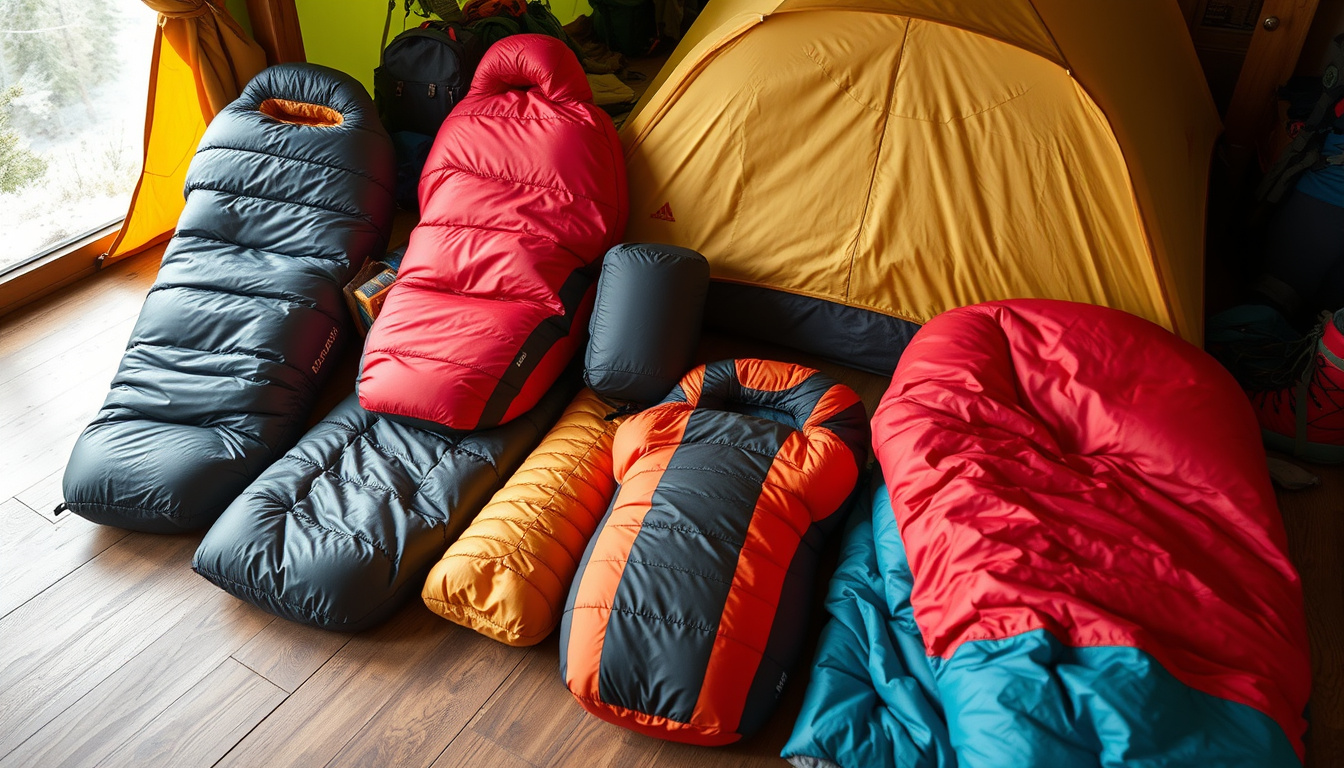
A sleeping bag for UK camping has to earn its place in the tent, the car and the rucksack. The choice comes down to four things: season rating, temperature rating, insulation type, and fit or size.
For most campers, the shortest route to a good night’s sleep is a 3-season bag for spring to autumn, a 4-season bag only when frost and snow are realistically on the list, and a fill type that matches the weather and the budget.
Down usually packs smaller and is lighter, while synthetic is typically better value and performs more reliably when damp. Those trade-offs appear again and again in British buying advice.
What is the difference between 3-season and 4-season sleeping bags?
Outdoor retailers in the UK consistently describe the 3-season bag as the all-rounder. It is built for spring to autumn use, handles cool to cold nights, and balances warmth, weight and price. A 4-season bag is a different piece of kit: it is designed for winter, frost and snow, and it is typically much warmer, bulkier and heavier. Cotswold Outdoor’s sleeping bag buying guide makes that distinction early in its advice.
Choose 3-season for general UK spring to autumn camping; 4-season for winter, mountains, or sub-zero conditions.
Baby sleeping bags should follow safe-sleep guidance: low-loft, fitted-neck design, no loose bedding, correct tog.
Separate the need for extra-large adult fit from double sleeping bags. Large is about sleeper dimensions; double is about two sleepers side by side.
Decathlon is a common price-led consideration; evaluate their sleeping bags against season rating, pack size, materials, and customer reviews.
A few patterns explain why buyers ask this question before anything else:
- Most sleeping bag research starts with a commercial intent: buyers know the category and need help choosing a season, size or brand.
- Season labels are not universal; temperature ratings are the real differentiator.
- Baby sleeping bag questions need safety-first guidance, not product placement.
- Large and double sleeping bags are frequently confused; they solve different problems.
- Decathlon comparisons are price-led, but season rating and materials deserve equal weight.
- UK conditions matter: damp cold, sea air and changeable nights make season advice especially useful.
The facts behind the labels hold steady across most UK guides:
| Factor | What the guides say |
|---|---|
| Season rating | 3-season bags cover spring to autumn; 4-season bags add cold-weather protection, wind resistance and warmer insulation. |
| Baby sleeping bags | Safe models are low-loft, fitted at the shoulders, and designed to avoid covering the head. |
| Large adult bags | Check shoulder girth, hip width and foot-box room, not just length. |
| Double sleeping bags | Sized for two people, but they can be harder to warm evenly than individual bags. |
| Comfort rating | The temperature at which a standard woman can sleep comfortably. |
| Lower limit | The temperature at which a standard man can sleep curled up without waking. |
| Extreme rating | Survival-only territory, not a comfort target. |
| Down insulation | Warm for its weight and highly compressible, but more expensive and less forgiving when wet. |
| Synthetic insulation | Better value, handles damp better and easier to care for, but usually bulkier and heavier. |
| UK 3-season comfort | Roughly 0°C to 5°C in many guides, or -3°C to -6°C in more conservative advice. |
What does ‘season’ mean on a sleeping bag label?
The season number is short-hand for the conditions a bag is built to handle. Season 1 means hot summer conditions only. Season 2 covers late spring to early autumn and mild weather. Season 3 is aimed at autumn and winter without frost, or generally cool to cold nights. Season 4 is for cold winter conditions, including frost and snow. Trail’s sleeping bag guide explains the scale in those terms.
Retailers describe the boundaries slightly differently, but the broad agreement is that 3-season is the UK all-rounder and 4-season is for winter.
What temperature rating is best for UK camping?
Temperature labels matter more than season numbers. Most reliable bags carry EN/ISO-style ratings: comfort is the temperature at which a standard woman can sleep comfortably, lower limit is the temperature at which a standard man can sleep curled up without waking, and extreme is survival-only territory. Alpkit’s guide to sleeping bag warmth defines those terms in plain language.
For UK 3-season camping, many guides suggest a comfort rating around 0°C to 5°C. More conservative guides recommend -3°C to -6°C as a safer single-bag choice for changeable British nights. The key safety rule is to match the comfort rating to the coldest night you expect.
Down or synthetic: which is better for damp UK nights?
Down is warmer for its weight, packs smaller and is highly compressible. It costs more and performs poorly when wet unless well protected. Synthetic insulation is the better choice if you expect damp conditions, want easier care, or need a lower price point. Mountain Warehouse’s sleeping bag guide puts those trade-offs side by side.
| Insulation | Strengths | Weaknesses | Best for |
|---|---|---|---|
| Down | Very warm for weight, highly compressible | Expensive, less forgiving when wet | Backpacking, low pack size, colder dry conditions |
| Synthetic | Better value, handles damp better, easier care | Bulkier and heavier | Budget buyers, wet UK conditions, car camping |
What are the safest sleeping bags for babies?
Baby sleeping bags are a safety product as much as a comfort product. The reliable reference points are The Lullaby Trust and NHS safer sleep advice. Both organisations describe baby sleeping bags as part of a safer sleep setup that avoids loose blankets and keeps the face clear.
The same broad season logic applies to children’s bags, but fit and safety matter more than buying the warmest model.
What should a safe baby sleeping bag avoid?
A safe baby sleeping bag should not cover the head, should fit closely at the shoulders, and should not be combined with loose bedding. It should also be the right size: an oversized adult bag leaves too much space and adds avoidable risk.
Why is low-loft sleeping bag advice recommended for babies?
Low-loft advice comes from the safe-sleep principle that babies should not overheat and should not have padding pressing against the face. The correct tog depends on room temperature, which is why NHS guidance focuses on checking the room and dressing the baby appropriately.
When can a baby use a sleeping bag?
The guidance does not set a single universal starting age. The practical rule is to follow the manufacturer’s size and weight guidance for the specific bag and to check current safer sleep advice before first use.
Adult sleeping bags are not a safe substitute for a baby. A baby sleep system should be low-loft, correctly sized, and designed for infant use, with the head and face always clear.
Which Decathlon sleeping bags are worth considering?
Decathlon is a common price-led consideration for UK campers, but none of the UK buying guides examined here names a specific Decathlon model. The honest approach is to apply the same criteria used for every brand: check the season rating, the comfort temperature, and whether down or synthetic suits your plans. Trekitt’s UK sleeping bag guide works from those fundamentals.
Are Decathlon sleeping bags good for 3-season camping?
Decathlon’s range includes 3-season models, but the label alone is not enough. Look for a comfort rating around 0°C to -6°C and read recent customer comments about warmth and sizing, because cut and fit vary by model.
Does Decathlon sell winter or 4-season sleeping bags?
The guides examined do not confirm which winter models Decathlon currently sells. The useful test for any candidate is the comfort rating: a genuine winter bag should keep you comfortable below 0°C rather than merely surviving the night.
What is the best Decathlon sleeping bag for beginners?
Among the UK buying guides examined, none names a single best beginner model. For a first bag in the UK, a sensible starting point is a 3-season synthetic bag with a comfort rating around 0°C. That combination keeps the price down and performs well in damp conditions.
Decathlon’s model availability and prices change quickly. Before comparing, confirm the current comfort temperature, season rating, fill type, packed size and recent customer reviews on the product page.
What should large adults look for in a sleeping bag?
A large adult sleeping bag is about giving one tall or broad sleeper enough room to stretch and turn. Length matters, but shoulder girth, hip width and foot-box room matter just as much. Trekitt’s sleeping bag knowledge centre treats fit as a core part of choosing well.
Shape also changes the equation. Mummy shapes are warmer and more efficient because they reduce dead air space, while wider or rectangular bags are roomier but usually less thermally efficient.
How wide is a large sleeping bag?
Large models add width as well as length, usually around the shoulders and hips. Extra internal air space makes a bag harder to keep warm, so unnecessary width works against you when warmth is the priority.
What length should an extra-large sleeping bag be?
Extra-large models extend length for taller users, but the guides examined do not publish a standard dimension table. Compare the stated length and girth against your own height, and read reviews from people of a similar build.
Are large sleeping bags the same as double sleeping bags?
No. A large bag fits one person with extra room; a double bag fits two people side by side. The two are often confused, but the buying criteria are completely different.
Fit-first thinking runs through UK comfort and gear guides. The Shoe Inserts 2025: The Ultimate UK Guide for Pain Relief and Fit applies the same logic to footwear: measure, match, and read the reviews before buying.
What is the best double sleeping bag for two people?
A double sleeping bag is a shared microclimate. It is sized for two sleepers and works well when both people have similar temperature needs. The main drawback is that a double bag can be harder to warm evenly than two individual bags. Fieldworthy’s UK sleeping bag review makes the same point about matching warmth to the sleeper.
Can two adults sleep comfortably in a double sleeping bag?
Yes, when both sleepers run at a similar temperature. If one sleeps hot and the other sleeps cold, the compromise usually leaves one person too warm and the other too cold.
What is the difference between a double sleeping bag and two single bags?
Two single bags give each person independent warmth control, and many models zip together to form a double. That is why some couples prefer a pair of singles over a fixed double bag.
Should couples choose a double sleeping bag with separate blankets?
The guides examined do not compare specific double bags with separate blankets. The point they do make is that double bags are harder to warm evenly, so separate layers are one reasonable way to manage different temperature needs.
Couples who sleep at different temperatures often do better with two single bags that zip together than with a fixed double bag, because each side can warm independently.
How should you plan a sleeping bag purchase?
A short, structured process removes most of the guesswork.
-
Pre-shopping.
Define the main users, the typical camping temperatures, and where the bag will be used. Decide whether it is for an adult, a baby, a couple, or a single tall adult, and pin down the lowest expected overnight temperature.
-
Shortlist.
Filter by season rating, size and occupancy, fill type, and brand. Make sure the bag has enough room at the shoulders and hips, and decide whether two singles with connecting zips make more sense than a double bag.
-
Verification.
Check the ISO thermal standard comfort rating rather than relying on marketing names. For baby bags, confirm the bag follows safe-sleep guidance. For down, check whether it is RDS-certified and whether the water-repellent treatment is PFAS-free.
-
Purchase.
Compare price, delivery, returns and recent verified customer feedback. Pay special attention to comments about warmth and sizing.
Which sleeping bag facts are settled, and which are not?
Some parts of sleeping bag advice are firmly established. Others depend on the sleeper, the site and the season.
| Established | Still uncertain |
|---|---|
| 3-season and 4-season labels are broadly understood across the outdoor industry. | Comfort temperature varies by individual sleeper, clothing, tent type, sleeping pad and humidity. |
| Baby sleeping bags should not be treated like adult sleeping bags; guidance from trusted health sources applies. | Manufacturer season labels are not perfectly standardized. |
| Home storage and care affect the lifespan and insulation performance of any sleeping bag. | Model availability and prices at Decathlon or other retailers change quickly. |
The practical consequence is simple: treat the season label as a starting point, buy on the comfort rating, and confirm current stock, measurements and reviews before paying.
Why do British campers focus on 3-season and 4-season sleeping bags?
UK conditions are rarely extreme, but they are changeable. Damp cold, sea air and nights that vary from the forecast make a single all-purpose bag a compromise too far for many campers. That is why season-specific advice appears so often in British buying guides. Met Office UK climate information provides regional temperature context for planning outdoor trips.
Baby sleeping bag safety follows the same seasonal logic at home as at a campsite. Room temperature and tog should be matched to the season, not to the destination.
Outdoor planning questions keep coming back to conditions. A climber tackling a serious peak faces a different set of decisions than a family camping for a long weekend, which is why guides such as Mountain Everest – Height, Facts, and Climbing Guide 2025 exist alongside general camping advice.
Which sources are worth trusting for sleeping bag guidance?
The most reliable guidance combines outdoor retail experience with health authority advice. A few positions recur across the sources.
Down is usually warmer for its weight and more compressible, while synthetic is the better choice if you expect damp conditions, want easier care, or need a lower price point.
Mountain Warehouse sleeping bag guide
Extreme ratings are not a comfort target. They are survival indicators, and choosing a bag on that number is not a safe way to plan a night outdoors.
Alpkit, Mountain Warehouse, Blacks
For babies, the safest sleeping bags are low-loft, fitted at the shoulders, and designed to keep the head clear. Adult bags are never a substitute.
The Lullaby Trust and NHS safer sleep guidance
For product safety and recall information, GOV.UK product safety guidance is the reference point for consumer protection in the UK.
What is the simplest way to choose a sleeping bag?
For most UK campers, the simplest reliable formula is a 3-season sleeping bag with a comfort rating around 0°C to -6°C, sized to your body and sleeping position. Choose down when pack size and weight matter most; choose synthetic when damp and budget matter more. For babies, follow safer sleep guidance rather than adult camping logic, and for couples, decide honestly whether you share the same overnight temperature.
Quick answers to other sleeping bag questions
How do I choose a sleeping bag for cold weather camping?
Choose a 4-season bag for frost and snow conditions, or a warm 3-season bag for cool autumn nights. Match the comfort rating to the coldest night you expect, and remember that extreme ratings are survival-only indicators.
What size sleeping bag does a large adult need?
Look at the stated length and girth, not just the size name on the label. Check shoulder girth, hip width and foot-box room. A large adult bag adds width and length, but excess space makes a bag harder to keep warm.
Which Decathlon sleeping bag is best for 3-season conditions?
No UK buying guide examined here names a single Decathlon model. Compare options using the same criteria as any brand: comfort temperature around 0°C to -6°C, season rating, fill type, packed size and current customer reviews.
How can a baby sleeping bag reduce SIDS risk?
Baby sleeping bags are part of safer sleep guidance because they reduce the need for loose bedding, which can cover a baby’s face. Choose a low-loft, correctly sized bag and follow current NHS and The Lullaby Trust advice on room temperature and tog.
What is the best 4-season sleeping bag?
No single model is named across the guides examined. A genuine 4-season bag keeps you comfortable well below 0°C and handles frost and snow, but expect it to be warmer, bulkier and heavier than a 3-season bag.
Double vs single sleeping bag: which is better for couples?
A double bag keeps two people together but can be harder to warm evenly. Two single bags that zip together let each sleeper choose their own warmth. Choose based on whether you both sleep at similar temperatures.

Oliver Reeves leads fact-checking, source verification and editorial standards at RegionalReport.co.uk.