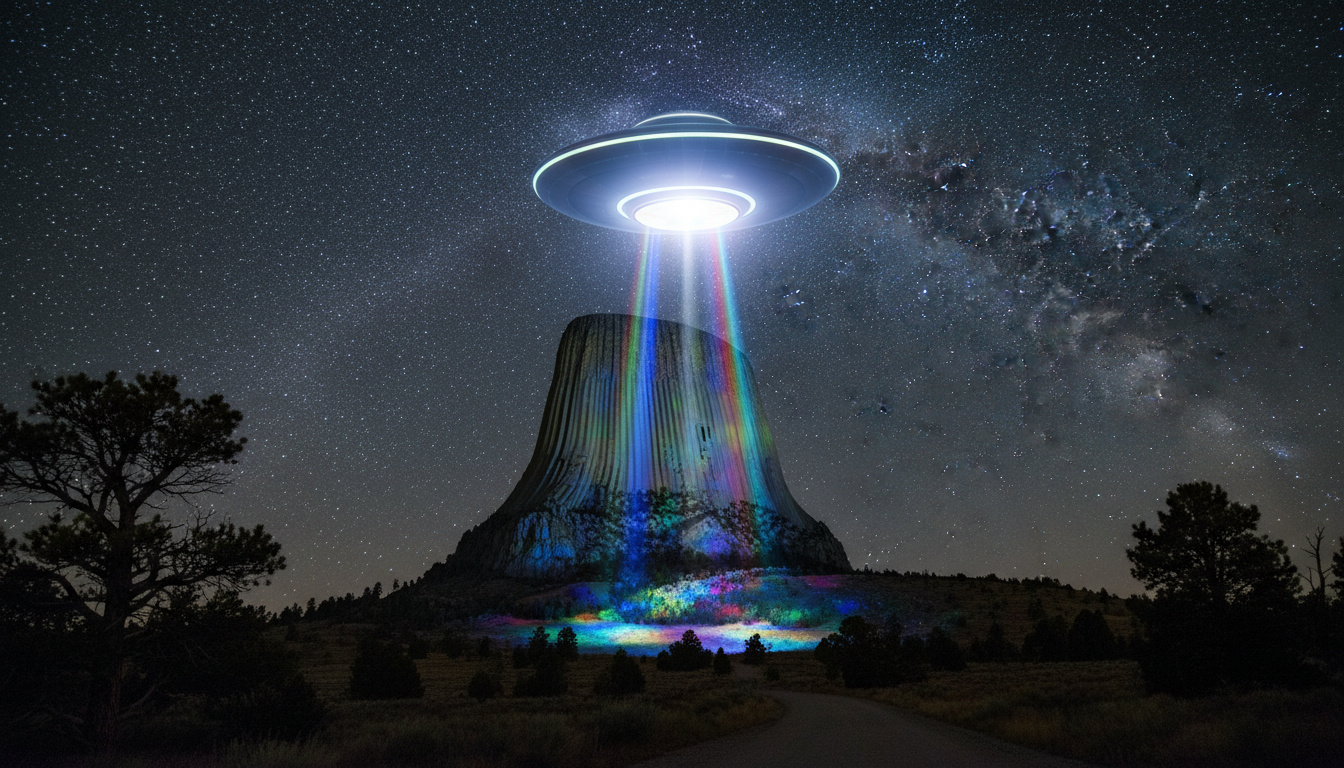
Close Encounters of the Third Kind stands as a landmark 1977 science fiction film that redefined cinematic depictions of extraterrestrial contact. Directed by Steven Spielberg, the production eschews invasion narratives in favor of communication and wonder, following ordinary Americans drawn into a government-sanctioned meeting with alien intelligence at a Wyoming mountain formation.
The film stars Richard Dreyfuss as Roy Neary, an Indiana electrical lineman whose UFO sighting sparks an obsessive quest toward Devils Tower. Blending documented UFOlogy with intimate character studies, the work earned Academy Awards for its technical achievements while grossing over $300 million worldwide, cementing its influence on subsequent science fiction cinema.
What Is Close Encounters of the Third Kind About?
The narrative follows Roy Neary, who encounters unidentified lights during a power outage investigation, suffering facial burns and receiving a psychic implant of a distinctive mountain shape. As his obsession alienates his family, he discovers the formation is Devils Tower, Wyoming, where the military has staged a toxic spill evacuation to conceal a massive UFO landing operation.
1977 (Special Edition 1980)
Steven Spielberg
137 minutes (original)
Science Fiction / UFO Thriller
- Box Office Performance: Grossed $307 million worldwide against a $20 million budget
- Academy Recognition: Won Oscars for Best Cinematography and Best Visual Effects
- Scientific Foundation: Based on astronomer J. Allen Hynek’s UFO encounter classification
- Iconic Score: Features the five-note musical communication motif
- Primary Location: Devils Tower National Monument serves as the climactic rendezvous point
- Cultural Shift: Pioneered benevolent alien depictions in mainstream Hollywood
- Dual Narrative: Parallel stories of Roy Neary and Jillian Guiler searching for her abducted son Barry
| Budget | $20 million |
|---|---|
| Box Office | $307 million worldwide |
| Theatrical Release | November 16, 1977 |
| Director/Writer | Steven Spielberg |
| Composer | John Williams |
| MPAA Rating | PG |
| Oscar Wins | 2 (Cinematography, Visual Effects) |
| Nominations | 6 including Best Director and Best Picture |
| Special Edition | Released 1980 with additional mothership scenes |
| 40th Anniversary | Restored theatrical release 2017 |
What Does ‘Close Encounter of the Third Kind’ Mean?
The title derives directly from the classification system developed by astronomer J. Allen Hynek, who advised the U.S. Air Force’s Project Blue Book investigation. Hynek categorized UFO encounters into three distinct types based on proximity and evidence quality.
First Kind: Visual sighting of an unidentified object. Second Kind: Physical evidence of a landing or interaction. Third Kind: Direct observation of extraterrestrial entities. Spielberg’s film specifically explores this third category, depicting not merely sightings but meaningful communication between species.
Hynek appears briefly in the film as a scientific advisor, lending authenticity to the production. His classification framework elevated ufology from sensationalism to structured observation, providing both the title and the philosophical foundation for the narrative’s treatment of contact.
Is Close Encounters of the Third Kind Based on a True Story?
The film is not adapted from any single verified incident but synthesizes documented UFO reports and aviation mysteries. The disappearance of Flight 19—five Navy bombers lost in the Bermuda Triangle in 1945—features prominently when the missing planes reappear in the Sonoran Desert with pristine engines but no crews.
Similarly, the SS Cotopaxi, a cargo vessel lost in the Atlantic, appears relocated to the Gobi Desert, fictionalizing real maritime disappearances. These elements reference actual unexplained events while maintaining narrative distance. Unlike the technological dystopias explored in Common People Black Mirror – Plot Cast Ending Explained, Close Encounters draws from historical anomaly databases rather than speculative extrapolation.
Who Directed Close Encounters of the Third Kind and Key Cast?
Steven Spielberg directed, wrote, and produced the feature following the success of Jaws (1975). Visual effects supervisor Douglas Trumbull orchestrated the complex UFO fleet sequences and the massive mothership landing, emphasizing practical effects over the nascent CGI technology of the era.
Richard Dreyfuss stars as Roy Neary, with Teri Garr as his estranged wife Ronnie. Melinda Dillon portrays Jillian Guiler, the mother searching for her abducted son Barry (Cary Guffey). French New Wave director François Truffaut appears as scientist Claude Lacombe, communicating through his interpreter David Laughlin (Bob Balaban).
Spielberg originally planned elaborate sequences featuring wire-suspended aliens floating around the mothership, but cut these elements when the effects proved unsatisfactory. The naturalistic 1970s performances differ markedly from contemporary genre acting styles, which enthusiasts can compare through resources like the Sienna Miller Movies and TV Shows – Complete Filmography Guide.
What Are the Five Tones and How Does the Film End?
The climactic communication relies on a five-note tonal sequence—Re, Mi, Fa, Sol, La—developed by composer John Williams. This motif represents a universal mathematical language transcending linguistic barriers, transmitted through light boards and synthesizers at the landing site.
Scientists use Curwen hand signs to correspond with the tones, establishing harmonic mathematics as a bridge between species. When Lacombe exchanges the sequence with a childlike alien at Devils Tower, the gesture confirms peaceful intent. Spielberg likened this dialogue to Cold War hopes for communication across ideological divides.
Devils Tower functions as the geographic and spiritual destination. The Wyoming monolith appears repeatedly in witnesses’ visions after subliminal implantation by the extraterrestrials. The Army secures the area by fabricating a nerve gas leak, allowing the mothership to land undisturbed.
At the landing site, UFOs release abductees taken decades earlier—including Flight 19 pilots and the Cotopaxi crew—unaged and unharmed. Following the tonal exchange, Roy Neary volunteers to depart with the aliens, entering the mothership as it ascends, chosen for his artistic sensitivity and curiosity.
The ending rejects invasion tropes in favor of peaceful exchange, emphasizing tolerance and wonder over fear. Barry Guiler returns to his mother, while Roy’s departure suggests humanity’s creative capacity qualifies certain individuals as interstellar ambassadors.
When Was Close Encounters of the Third Kind Produced and Released?
- : Spielberg develops the script, synthesizing UFOlogy research and personal themes regarding obsession and family.
- : Principal photography occurs across Mobile, Alabama and Devils Tower, Wyoming.
- : Theatrical release by Columbia Pictures becomes the year’s second-highest grossing film after Star Wars.
- : Academy Award nominations announced for Best Director, Best Picture, and technical categories.
- : Special Edition released with additional mothership interior scenes that Spielberg later reconsidered.
- : 40th anniversary theatrical re-release restores the original 1977 cut while preserving select visual enhancements.
What Is Established Fact Versus Speculation?
| Verified Information | Fictional or Uncertain Elements |
|---|---|
| Released November 16, 1977 | Return of Flight 19 aircraft (fictionalized) |
| Directed and written by Steven Spielberg | Specific alien biology and technology |
| Based on Hynek’s classification scale | Actual use of Devils Tower for contact |
| $20 million budget, $307 million gross | Existence of the mothership vessel design |
| Won two Academy Awards | Spielberg’s personal beliefs about extraterrestrial life |
| Hynek cameo appearance verified | Specific fates of returned abductees |
How Did Close Encounters Influence Science Fiction Cinema?
The film fundamentally altered cinematic depictions of alien intelligence. Prior to 1977, extraterrestrials largely served as metaphors for invasion or existential threat. Spielberg’s vision introduced benevolent, childlike beings interested in communication, directly influencing E.T. the Extra-Terrestrial (1982) and establishing the “everyman protagonist” template for speculative fiction.
Culturally, the production popularized ufological terminology, embedding “close encounters” into mainstream lexicon. Its emphasis on ordinary characters experiencing wonder rather than military personnel confronting threats demonstrated that audiences would embrace ambiguous, non-violent resolutions to contact narratives.
What Did the Filmmakers Say About the Production?
“I really modeled the film after the David and Goliath story. I wanted to tell a story about a little guy against a big bureaucracy.”
— Steven Spielberg on government secrecy themes
“If you can establish a tonal language that is mathematically correct, you have bypassed the linguistic barriers that separate species.”
— John Williams on composing the alien communication
Why Does Close Encounters of the Third Kind Endure?
Nearly five decades after its release, the film retains its power through the authenticity of its human drama and the optimism of its cosmic vision. By grounding extraterrestrial contact in recognizable emotions—obsession, parental love, scientific curiosity—Spielberg created a work that transcends its science fiction trappings. The movie stands as a document of 1970s American aspiration, offering a vision of interspecies contact built on music and mathematics rather than conflict. For those interested in the evolution of performance styles from this era to contemporary cinema, the Sienna Miller Movies and TV Shows – Complete Filmography Guide provides comprehensive context.
Frequently Asked Questions
What is Devils Tower in Close Encounters?
Devils Tower is a real National Monument in Wyoming that serves as the landing site for the alien mothership. In the film, extraterrestrials implant visions of the formation in witnesses’ minds to guide them to the rendezvous point.
Did Close Encounters of the Third Kind win any Oscars?
Yes, the film won two Academy Awards for Best Cinematography and Best Visual Effects. It received additional nominations for Best Director, Best Picture, Best Original Score, and Best Film Editing.
What is the five-tone sequence in the film?
The five tones are Re, Mi, Fa, Sol, La—a musical phrase used by humans and aliens to establish communication. Composer John Williams created the motif to represent a universal mathematical language.
Is Devils Tower a real location?
Yes, Devils Tower is a legitimate geological formation located in northeastern Wyoming. It was the first United States National Monument, established in 1906.
Who played the little boy in Close Encounters?
Cary Guffey portrayed Barry Guiler, the young boy abducted by aliens. His performance was notable for being genuinely reactive to off-camera cues rather than scripted direction.
What happened to Roy Neary at the end?
Roy Neary volunteers to leave Earth and boards the alien mothership. Selected by the extraterrestrials as a peaceful ambassador, he departs with them as the ship ascends.
Was François Truffaut primarily an actor or director?
François Truffaut was a renowned French New Wave director who occasionally acted. In Close Encounters, he plays scientist Claude Lacombe while continuing his directing career.

Amelia Grant is Local Government Editor at RegionalReport.co.uk, covering council decisions, regional public policy, combined authorities, planning, housing and transport.