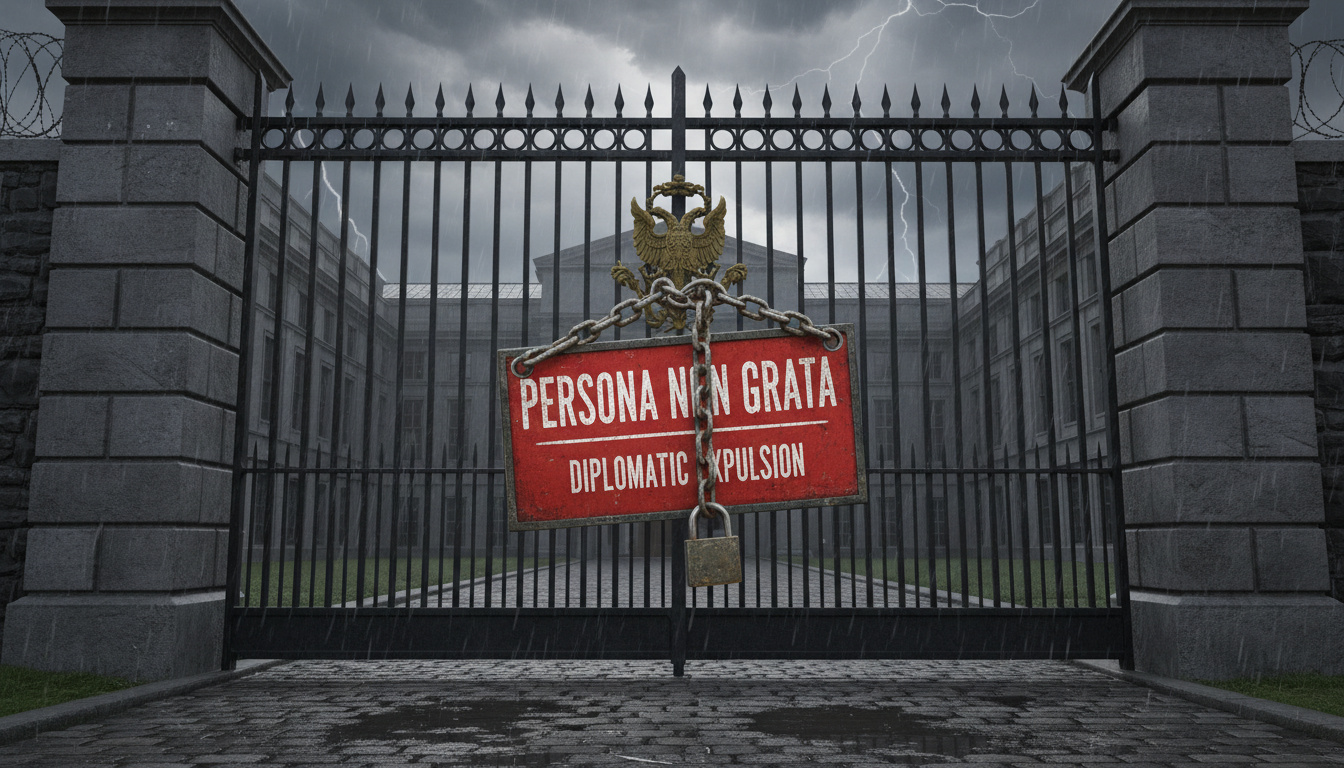
The phrase persona non grata signals one of diplomacy’s most pointed rebukes. Latin for “an unwelcome person,” the term designates individuals—typically foreign diplomats—whom a host country deems unacceptable, often triggering immediate departure without formal charges or trial.
Contemporary definitions emphasize its role in international relations, yet the expression has migrated into everyday language to describe anyone falling from social favor. Understanding its precise application requires distinguishing between diplomatic protocol and common parlance, examining historical precedents, and recognizing the legal mechanisms that transform a Latin phrase into an order to leave a country within days.
What Does ‘Persona Non Grata’ Mean?
Latin for “unwelcome person”
Diplomatic expulsion signal
Vienna Convention Article 9
Common during international tensions
- Unilateral authority: Host governments need not justify declarations to the target or international courts.
- Immediate immunity loss: Recognition refusal ends diplomatic protections instantly.
- Rapid departure: Individuals typically must exit within 48–72 hours.
- Reciprocal potential: Home nations often respond by declaring equivalent PNG status against the host’s diplomats.
- Relation preservation: The tool signals severe displeasure without formally severing bilateral ties.
- Beyond embassies: The phrase applies figuratively to social and business contexts.
| Fact | Details |
|---|---|
| Latin Phrase | Persona (person) + non (not) + grata (welcome) |
| First Recorded Use | Diplomatic contexts post-1961 Vienna Convention |
| Declaring Authority | Host government |
| Duration | Typically permanent unless withdrawn |
| Non-Diplomatic Use | Figurative in social/business settings |
What Is the Origin of ‘Persona Non Grata’?
The term derives directly from Latin persōna (“person”) + nōn (“not”) + grāta (from grātus, “pleasing” or “acceptable”), literally meaning “an unacceptable person.” Etymological records trace the construction to classical roots, though its diplomatic application emerged centuries later.
First recorded in English around 1885–1890, the phrase entered diplomatic vocabulary in the 20th century. Early examples appeared by 1956, when references to unwelcome figures in international relations began appearing in official communications. The dictionary entry notes the transition from classical literature to modern statecraft.
How Is ‘Persona Non Grata’ Used in Diplomacy?
Who Can Declare a Person Persona Non Grata?
Only the receiving state—the host country—possesses authority to declare a foreign diplomat persona non grata. This power rests exclusively with the host government, which may act through its foreign ministry or head of state. The declaration requires no judicial approval or international oversight.
Article 9 of the Vienna Convention explicitly states that the receiving state may declare a diplomat persona non grata “at any time” and without obligation to explain reasons. This unilateral privilege represents a fundamental aspect of sovereignty within diplomatic relations.
What Is the Difference Between Persona Non Grata and Expulsion?
Persona non grata applies exclusively to diplomats protected by immunity, requesting voluntary recall. Expulsion targets non-diplomats—citizens or visitors—via deportation orders enforceable by domestic law without immunity complications. PNG is diplomatic protocol; expulsion is sovereign police action.
The distinction matters legally. Diplomats declared PNG lose immunity only after refusing recall, while expelled individuals never possessed such protections. Host nations use PNG to avoid awkward prosecutions of immune officials; expulsion handles immigration violations or criminal matters among ordinary residents.
What Are Notable Examples of ‘Persona Non Grata’ Declarations?
Historical precedents illustrate the tool’s versatility across eras. During Cold War tensions, intelligence operatives faced PNG status when host governments uncovered espionage activities without desiring public trials that would reveal counterintelligence methods. Diplomatic records cite ambassadors whose controversial remarks triggered declarations, straining bilateral relations while avoiding formal ruptures.
Specific identities of declared diplomats often remain confidential to prevent further escalation or retaliation between nations.
Political activists occasionally receive PNG designations for anti-government protests, resulting in travel bans and exclusion from future entry. In broader contexts, environmentalist James Lovelock became persona non grata in certain scientific circles for contrarian climate views, while Paul McCartney referenced friends as personae non gratae following personal disputes. Nations continue declaring diplomats PNG amid modern geopolitical tensions, though specific identities often remain confidential to prevent further escalation.
The Oxford Historian Faces Deportation – Visa Refusal Timeline and Appeal illustrates how immigration authorities handle non-diplomatic removals, contrasting with the diplomatic finesse required for PNG declarations.
What Happens After Being Declared ‘Persona Non Grata’?
Can Someone Declared Persona Non Grata Return?
Return remains theoretically possible but practically rare. The status typically persists indefinitely unless the host government explicitly withdraws the declaration. Diplomatic conventions place no mandatory expiration on PNG designations, effectively creating lifetime bans for the individual named.
Some nations have rescinded declarations as political climates improved, though such reversals require explicit diplomatic negotiations. The individual cannot unilaterally appeal the decision; only the declaring state holds authority to restore welcome status.
What Are the Legal Implications?
Under international law, PNG declarations are unilateral and non-reviewable. No appeal exists; the convention mandates compliance to prevent arrests or prosecutions during diplomatic status. The diplomat must depart promptly—often within days—or face immunity revocation.
Declarations occur via official notification to the diplomat’s mission. The individual loses privileges immediately upon refusal of recognition, potentially facing detention if remaining beyond the stipulated departure window. Home countries frequently retaliate by declaring reciprocal PNG status against the host nation’s diplomats, creating symmetrical expulsions that reduce embassy staff on both sides.
When Has ‘Persona Non Grata’ Been Used Throughout History?
-
Early diplomatic precedents emerge following the Congress of Vienna, establishing informal customs for removing undesirable foreign representatives.
-
The Vienna Convention on Diplomatic Relations codifies PNG status in Article 9, standardizing the declaration process across international law.
-
Cold War spy scandals trigger mass PNG declarations between Eastern Bloc and NATO nations, with diplomats expelled amid intelligence controversies.
-
Recent Russia-US diplomat cases demonstrate continued relevance, with reciprocal declarations amid modern geopolitical tensions.
What Is Certain vs. Uncertain About ‘Persona Non Grata’?
| Established Information | Information That Remains Unclear |
|---|---|
| Standard diplomatic term recognized under international law | Exact return timelines vary by bilateral negotiation rather than fixed rules |
| Expels diplomats without requirement for criminal trial or evidence | Withdrawal of PNG status remains rare and politically discretionary |
| Host government holds exclusive declaration authority | Specific criteria triggering declarations differ between nations |
How Does ‘Persona Non Grata’ Fit Into Modern Contexts?
Beyond embassy corridors, the phrase describes any unwelcome individual—from obnoxious guests at social gatherings to blacklisted business partners. Modern usage extends to clubs, organizations, and online communities where members face exclusion for violating norms.
Countries like the Philippines and Spain employ non-binding resolutions to declare non-diplomats—citizens violating local laws—persona non grata, expressing communal disapproval without legal enforcement. These symbolic declarations carry moral weight but lack immigration consequences. Kate Middleton Prince Louis Royal Balcony – 2024 Cheeky Moments demonstrates how public figures navigate social acceptance, a civilian parallel to diplomatic welcome.
The plural forms personae non gratae (preferred) or the proscribed personas non grata appear in academic and legal texts, maintaining the Latin grammatical structure even in English contexts.
What Do Authoritative Sources Say?
The receiving State may, at any time and without having to explain its decision, notify the sending State that the head of the mission or any member of the diplomatic staff of the mission is persona non grata or that any other member of the staff of the mission is not acceptable.
Article 9, Vienna Convention on Diplomatic Relations
This foundational text, available through diplomatic briefings and treaty archives, establishes the absolute authority of host nations. The provision’s phrasing—”without having to explain its decision”—deliberately protects state sovereignty while preventing diplomatic immunity from shielding undesirable activities indefinitely.
What Is the Essential Understanding of Persona Non Grata?
Persona non grata represents a sovereign tool for removing unwelcome diplomats without criminal prosecution or bilateral rupture. Rooted in Latin etymology and codified by the 1961 Vienna Convention, the designation demands rapid departure while preserving formal relations. Its usage spans from Cold War espionage to modern geopolitical tensions, with consequences ranging from immediate immunity loss to potential reciprocal expulsions. Understanding this mechanism clarifies how nations manage diplomatic crises while maintaining the fiction of ongoing dialogue.
Frequently Asked Questions
Is persona non grata used outside diplomacy?
Yes. The term describes unwelcome individuals in social, business, or organizational contexts. Countries also issue non-binding PNG resolutions against citizens to express disapproval without legal force.
How long does persona non grata status typically last?
Typically permanent unless the declaring state withdraws the designation. No automatic expiration exists under international law; restoration requires explicit diplomatic negotiation.
Does declaring persona non grata require specific evidence?
No. Article 9 of the Vienna Convention explicitly requires no explanation or justification for the declaration, allowing host states to act on undisclosed intelligence or political considerations.
Can non-diplomats be declared persona non grata?
Strictly speaking, PNG applies only to diplomats with immunity. However, some nations use the term figuratively in resolutions against ordinary citizens, though these carry no legal immigration consequences.
What happens to family members of a declared diplomat?
Family members holding diplomatic visas typically lose derived privileges simultaneously and must depart with the declared individual, though specific timelines vary by host nation protocols.
Can a persona non grata declaration be withdrawn?
Yes, but withdrawals are rare and politically sensitive. The declaring government must formally notify the sending state to restore diplomatic recognition and privileges.
How does persona non grata affect bilateral trade relations?
Individual PNG declarations rarely disrupt trade directly, serving as calibrated signals rather than sanctions. However, mass expulsions may precede broader economic tensions.

Amelia Grant is Local Government Editor at RegionalReport.co.uk, covering council decisions, regional public policy, combined authorities, planning, housing and transport.